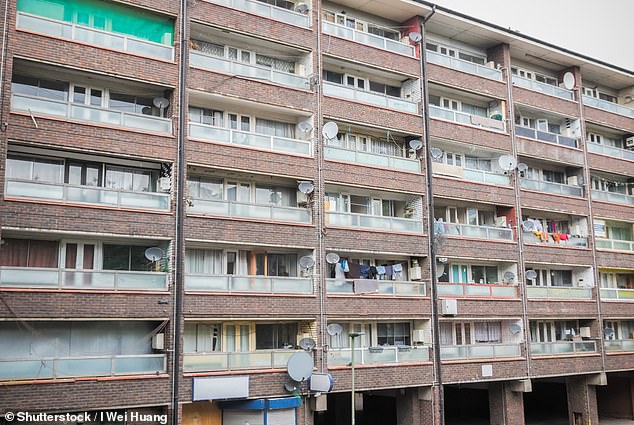

I live by a flat which is being used as a House in Multiple Occupation. Different men and women live in the flat for anything from a few days, to weeks and months.
The flat was previously registered as a former HMO with our local authority, but still seems to be used as one.
I’ve put up with lots of antisocial behaviour from different residents in the flat for years. It’s hellish.
I have written to the local authority, the landlord and reported the problems to the police, to no avail.
I would like to apply for an injunction given the residents’ intolerable and repetitive behaviour.
My understanding is there is a high threshold for injunction applications and it has to be evidenced by, for example, visits to your doctor to prove there is an issue.
Yet, my awful neighbours are continuing to get away with their behavior. What are my options?

Suffering: A Daily Mail reader lives near a flat seemingly being used as a HMO flat
Jane Denton, of the Daily Mail, replies: If someone lets their property to several tenants who are not from the same family, it may be an HMO.
You mention that the flat was previously registered as an HMO. Check that the property remains registered as an HMO. Flats can be used as an HMO.
An HMO must have a licence if it is occupied by five or more people. A council can also include other types of HMOs for licensing.
The council is responsible for enforcing HMO standards and can make a landlord take action to correct any problems.
The usual rules that apply to for landlords and tenants also apply to all HMOs.
In your case, the landlord is responsible for ensuring complaints of antisocial behaviour concerning the HMO are dealt with correctly.
Complaints about HMO properties can sometimes be extreme and persistent due to the number of people living in them and high turnover.
Antisocial behavior can encompass anything from noise to the use or supply of controlled drugs, criminal behavior and violence.
It could also stem from a failure to properly store and present rubbish and recycling for collection.
You have already complained to the landlord, council and police about the matter, but not got anywhere.
The council will expect the landlord to demonstrate that they are taking all reasonable steps to try to resolve your complaint regarding the ongoing antisocial behavior.
In some cases, it may be possible to apply to the courts for an injunction to prohibit a tenant or tenants from engaging in conduct causing or likely to cause antisocial behavior.
As you suggest, keeping evidence of all the antisocial behavior incidents is crucial. In extreme antisocial behavior cases, a closure order can be made on a property.
To determine if a pursuing an injunction or other course of action is the best option for you, I asked two solicitors to look at your question.
Liam Waine, a partner at Stephensons, says: When antisocial behaviour becomes intolerable, it can feel overwhelming and difficult to know how to put a stop to it.
From what you have described, it sounds like you’ve already contacted the landlord without much success.

The landlord of the HMO has responsibilities, Liam Waine says
Before pursuing alternative legal options, I would strongly recommend re-engaging with them again.
If the property is still operating as a HMO, the landlord has clear legal responsibilities under the Housing Act 2004, including a duty to manage the property properly, prevent antisocial behaviour, and ensure the safety and wellbeing of tenants and neighbours.
It may help to remind them of these obligations and make it clear that you have already escalated the matter to the local authority and will do so again if necessary.
You might also want to mention that you are considering legal advice.
This kind of pressure can sometimes prompt a more proactive response.
If you have reported three or more incidents to your local authority and feel your concerns have not been addressed, you can request a case review.
This compels the relevant agencies to formally review how your complaints have been handled.
If the authorities remain unresponsive, legal remedies such as injunctions may be available, although, as you rightly pointed out, they come with a high threshold.
You may be able to apply for an injunction yourself under the Protection from Harassment Act 1997, particularly if the behaviour is targeted and persistent.
To succeed, you will need to show that the conduct has occurred at least twice and has caused you alarm or distress.
Evidence is crucial. Keep a detailed log of any incidents, gather police reference numbers, witness statements, and, if applicable, medical records that show the impact on your health.
Finally, there is support available. Charities like ASB Help and Victim Support can guide you through the process, and I would also recommend speaking to a solicitor experienced in neighbour disputes to explore your legal options further.
Manjinder Kaur Atwal, a housing solicitor at Duncan Lewis, says: Few situations are more frustrating than living next to a property that functions like a revolving door.
Constant tenant turnover and persistent anti-social behaviour can disrupt sleep, affect mental health, and create an ongoing sense of insecurity.

An injunction is no quick fix, Manjinder Kaur Atwal says
These problems are particularly acute in former HMOs that continue to operate without proper oversight, leaving neighbours to shoulder the consequences.
There are strict rules around HMOs, and failure to manage them properly can be costly for landlords.
An injunction is one legal route worth exploring, though it is not a quick fix.
Under the Anti-social Behaviour, Crime and Policing Act 2014, councils and the police can apply for injunctions to prevent individuals from harassing, alarming, or distressing others.
Individuals can also apply through the county court, though the court requires robust evidence: incident logs, dates and times of disturbances, photographs or recordings, correspondence with landlords or councils, and witness statements where possible. Medical evidence demonstrating the impact on your health can strengthen a case but is not essential.
Given the property’s HMO history, it is crucial to check whether it still holds a valid licence.
Licences are issued and managed by the local council, many of which maintain public registers for residents to verify a property’s status.
You can also contact the council’s housing enforcement or HMO team directly, or request proof from the landlord, who is legally obliged to provide it.
Operating without a licence is illegal, and councils can prosecute or impose fines of up to £30,000.
Persistent inaction can be escalated via formal complaints, the Local Government and Social Care Ombudsman, or intervention by your local MP.
In addition to injunctions, councils and police can pursue closure orders for properties linked to repeated antisocial behaviour.
These can temporarily restrict access, prohibit specific individuals from entering, and be obtained quickly in urgent cases.
They are particularly effective in multi-occupancy homes where one tenant’s behaviour affects multiple households.
The key to success is meticulous record-keeping: log every incident, note who was involved, and maintain evidence of your reports.
This strengthens applications for injunctions, complaints to the council, and any potential legal action.
While injunctions can play an important role, consistent escalation through local authority enforcement often produces more immediate and sustainable results.
Residents should seek advice from a housing solicitor or Citizens Advice, who can guide them on the full range of civil and regulatory remedies available.
#injunction #antisocial #HMO #neighbours