
In the summer of 1999, then-Secretary of State for Education and Employment David Blunkett stood before Parliament and declared a quiet revolution in British classrooms.
Backed by £55million of funding and a new army of specialist teachers, the National Numeracy Strategy aimed to tackle a startling truth: nearly 40 per cent of eleven year olds were falling short of basic maths standards.
Fast forward 26 years. Despite the improvements brought about by that strategy, the UK still lags behind.
Research from Barclays found that two in five adults leave school feeling they are ‘not good at maths’.
There are compelling reasons to get this right. Education is not only a cornerstone of the UK’s soft power, but also a driver of our domestic prosperity.

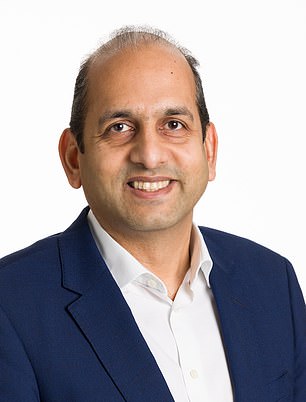
Vim Maru: Barclays boss says better maths education is vital to Britain’s success
High numeracy skills are linked to better employment opportunities, higher salaries and better financial decision-making, with Barclays’ research finding that half of UK adults recognise that stronger number skills would improve their money management.
A nation that is informed and equipped to make good financial decisions can help unlock economic growth.
This is Money recently pointed to research which suggests improved financial literacy could boost the economy.
This week is charity National Numeracy’s Number Confidence Week, presenting an opportunity to recommit to a shared ambition to transform number skills and build financial confidence.
Why now? Over £5trillion will change hands in the UK in the coming decades as the ‘great wealth transfer’ between generations unfolds. Today’s young people will inherit, manage and invest this wealth.
Economic pressures are adding further complexity. Inflation in 1999 was 1.5 per cent.
This September, it was 3.8 per cent – and Barclays data shows that 86 per cent of people are concerned about the impact of inflation on their finances, with almost half of people planning to cut down on discretionary spending due to rising household bills.
Against this backdrop, individual confidence with numbers and money is essential. Our relationship with money begins in childhood.
While maths is the country’s most popular A-Level, far too many young people stop engaging with numbers after age 16, or don’t see the way that translates into managing money.
This Wednesday, Barclays and National Numeracy will lead a school assembly in which we’re set to help 150,000 children nationwide to build their confidence with numbers and money.
It’s a powerful moment to inspire the next generation to feel confident with numbers and ready for the financial opportunities and challenges ahead.
We’re also training numeracy champions to support dozens of primary schools and over 13,000 children, parents, carers and teachers.
The quiet revolution that began in 1999 is unfinished.
The challenge is louder, the stakes higher and the context is evolving. If we want the next generation to thrive and the economy to grow, we must close the numeracy gap – starting now. Let’s make this our legacy.
SAVE MONEY, MAKE MONEY

Sipp cashback
Sipp cashback
£200 when you deposit or transfer £15,000

4.53% cash Isa
4.53% cash Isa
Trading 212: 0.68% fixed 12-month bonus

£20 off motoring
£20 off motoring
This is Money Motoring Club voucher

Free shares bundle
Free shares bundle
Get free UK shares worth up to £200

4.45% Isa with bonus
4.45% Isa with bonus
Now with no penalty for withdrawals
Affiliate links: If you take out a product This is Money may earn a commission. These deals are chosen by our editorial team, as we think they are worth highlighting. This does not affect our editorial independence. Terms and conditions apply on all offers.
#Britain #numeracy #wake #call #unlock #growth #Barclays #boss #VIM #MARU