
Ayrton Senna’s win at the 1991 Brazilian Grand Prix is unquestionably the Formula One legend’s most emotional – and arguably the most important – of his 41 career victories.
Having failed to take the top step of the podium at his home grand prix in seven previous attempts, the three-time F1 champion finally realised a personal dream in ’91 when he crossed the finish line almost three seconds ahead of Italian Riccardo Patrese.
Having seen the chequered flag at the Interlagos circuit in his native city of São Paulo, the then two-time F1 champion – who would go on to lift his third crown that season – appeared more animated than fans had ever seen him before, and would see him again.
That’s because victory was almost cruelly snatched from his fingertips in the final stages of the race.
In the last few laps, Senna’s McLaren’s gearbox was failing and left him no other option but to drive in sixth gear. Yet, the Brazilian’s mastery saw him overcome what should have forced a retirement to wrestle the car to victory, taking an immense toll on his body in the process and – once over the finish line – sending his muscles into spasms so violet he couldn’t get out of his seat unaided.
In interviews straight after the race, he said: ‘It wasn’t the greatest win of my life but it was the hardest fought,’ which only cemented the victory in motorsport mythology.
And the very car the Brazilian piloted that day is now being offered to the highest bidder…

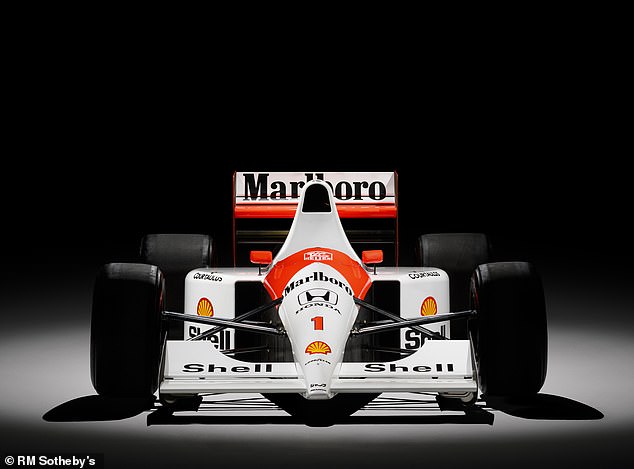
One of the most significant Formula 1 cars in existence: This is the McLaren MP4/6 that Ayrton Senna piloted to victory at the 1991 Brazilian Grand Prix. In December, it will be offered to the highest bidder

Having failed to take the top step of the podium at his home grand prix in seven previous attempts, the three-time F1 champion finally realised a personal dream in ’91 in this very car
Respected car auctioneer RM Sotheby’s will offer Ayrton Senna’s 1991 Brazilian Grand Prix–winning McLaren MP4/6 – chassis MP4/6/1 – via its ‘sealed’ platform with anonymous bidding taking place from 8 to 11 December.
And the auction house reckons it will take a bid of between $12million (£9.2million) and $15million (£11.5million) to secure what is a cornerstone of McLaren and Formula 1 history.
‘Few figures in motorsport have captured the world’s imagination like Ayrton Senna,’ said Nick Wiles, RM Sotheby’s car specialist.
‘Anything connected to him, a helmet, a suit, even something he once touched, has become sacred to collectors.
‘Senna transcended the role of driver long before his tragic passing; he became an icon.
‘But even within that realm, there are levels, and this car sits at the very top.
‘The McLaren MP4/6 that carried him to victory at his home Grand Prix in Brazil, in what Senna himself called the ‘hardest-fought race of his life,’ represents the pinnacle of Formula 1 collecting.
‘It’s difficult to imagine anything more significant or more desirable to a collector.’

Respected car auctioneer RM Sotheby’s will offer Ayrton Senna’s 1991 Brazilian Grand Prix–winning McLaren MP4/6. It reckons the winning bid will be between $12m (£9.2m) and $15m (£11.5m)

Chassis MP4/6/1 was Senna’s first experience with the Honda V12-powered machine that would carry him to his third and final World Championship

Of just 11 MP4/6 chassis built, this example is uniquely distinguished as first built and holding a 100 per cent win record – though it was started the one race in São Paulo

Senna won his first home race in F1. He led from pole position, but the victory was not without plenty of drama…
Chassis MP4/6/1 was Senna’s first experience with the Honda V12-powered machine that would carry him to his third and final World Championship.
Of just 11 MP4/6 chassis built, this example is uniquely distinguished as first built and holding a 100 per cent win record – though it was started the one race in São Paulo.
Senna won the race from flag to flag, though not without plenty of drama.
Having already faced challenging conditions, with heavy rainfall during the race, on lap 60 of 71 the McLaren’s gearbox lost fourth gear.
And with just two laps remaining, fifth and third gears were also gone, forcing Senna to use sixth gear, even in the slowest corners with the car on the brink of stalling.
When he crossed the finish line, Senna’s team radio captured the frantic screaming and wailing of the Brazilian driver, clearly overwhelmed by taking victory in front of some 70,000 of his adoring fans.
However, the combination of the tremendous struggle of trying to keep the car under control and his erratic celebrations caused severe muscle cramps and fever.
After stopping his car, Senna was almost unable to move due to exhaustion – and even had to be transported to the podium by a medical car.
On the top step, Senna was left grimacing as his battered body could barely muster the strength to lift the trophy – an image that has become legendary in F1 folklore.

Having already faced challenging conditions, with heavy rainfall during the race, on lap 60 of 71 the McLaren’s gearbox lost fourth gear. By lap 69, he could only drive in sixth gear, with the car on the brink of stalling at slower corners

When he crossed the finish line, Senna’s team radio captured the frantic screaming and wailing of the Brazilian driver, clearly overwhelmed by taking victory ahead of Williams’ Ricardo Patrese (left) and team-mate Gerhard Berger (right). However, the exhaustion he endured during and post race caused severe muscle cramps and fever

On the top step of the podium, Senna was left grimacing as his battered body could barely muster the strength to lift the trophy or a bottle of champagne to pour over his head – an image that has become legendary in F1 folklore
For the rest of the 1991 season, chassis MP4/6/1 served as a factory development test car for Senna, team-mate Gerhard Berger, and official McLaren test drivers.
Following its retirement from testing in October 1991, it remained in McLaren’s possession for nearly 30 years before being recommissioned by McLaren Heritage upon the acquisition by its sole private owner in 2020.
‘The MP4/6 represents the end of an era, the last manually shifted car to win a Formula 1 World Championship, and the final triumph of the legendary McLaren Honda partnership,’ Sotheby’s said.
‘Its impact endures as a symbol of Senna’s brilliance, McLaren’s engineering dominance, and the raw, mechanical purity of early 1990s Formula 1.’

Following its retirement from testing in October 1991, it remained in McLaren’s possession for nearly 30 years before being recommissioned by McLaren Heritage upon the acquisition by its sole private owner in 2020

RM Sotheby’s says the car is a ‘symbol of Senna’s brilliance, McLaren’s engineering dominance, and the raw, mechanical purity of early 1990s Formula 1’

The auction house added: ‘MP4/6/1 offers a rare chance to own the machine that encapsulates Senna’s genius and McLaren’s golden age’

Formula One famously switched to V12 power in 1991, with McLaren using this ferocious Honda power unit. The V10 engine from Senna’s 1990 car sold earlier this year for almost £200k
The auction house added: ‘MP4/6/1 offers a rare chance to own the machine that encapsulates Senna’s genius and McLaren’s golden age.
‘Considered by many to be one of the most significant Formula 1 cars in existence, it would surely be welcomed with open arms to any top-tier automotive event, and would make a significant addition to any collection worldwide.’
Earlier this year, the last Honda V10 engine Senna ever raced was sold at auction for a staggering amount.
This engine unit was fitted to Senna McLaren for the 1990 Japanese GP, in which he famously collided with rival Alain Prost’s Ferrari, with the Brazilian securing his second world title as a result of the pair failing to finish.
It also powered Senna’s car for final race of the season in Adelaide at the Australian Grand Prix. While Senna crashed out, this is the last V10 engine Senna used before the switch to V12 power for the 1991 season.
The 10-cylinder powerplant – offered direct from Honda Japan – alone sold for $254,500 (£195,250).
Even if Senna’s McLaren sells towards the top end of pre-sale guide price next month, it will be a fraction of the most expensive F1 car sold at auction.
That title goes to the 1954 W 196 R Stromlinienwagen driven by F1 royalty: both five-time champion Juan Manuel Fangio and the late British racing icon, Sir Stirling Moss.
In February, it eclipsed its pre-sale estimate of €50million (£42million) when bidding closed and the hammer dropped at a staggering €51,155,000 (£42.75million) – more than anyone’s paid before for a Grand Prix machine past or present.
The previous record was £29.6m (19.6m), which was also for a Mercedes driven by Fangio – the W196 S from 1954 sold at a Bonhams auction hosted at Goodwood in 2013.
#Ayrton #Sennas #iconic #race #winning #car #sold #auction #11million