
The Bank of England opted to hold interest rates at 4 per cent once again today, with a cut in December now thought likely.
The knife-edge vote saw five members of the Bank’s Monetary Policy Committee vote to keep the base rate at 4 per cent, while four members voted to reduce it to 3.75 per cent.
It is the second time the rate has been held following the bank’s previous decision in September.
In August, the bank cut interest rates from 4.25 to 4 per cent, down from a high of 5.25 per cent the previous year.
The next decision will take place on 18 December, with the majority of analysts now expecting a cut to 3.75 per cent.
The decision will hinge on what happens to the rate of inflation, but also the health of the overall economy and the impact of the Budget on 26 November.
Today’s decision to hold rates is bad news for households hoping to see the cost of their mortgage reduce.
However, it will be received positively by savers, as interest on their accounts usually falls when the base rate goes down.
We explain what the Bank of England’s decision to hold rates at 4 per cent means for your mortgage and savings.

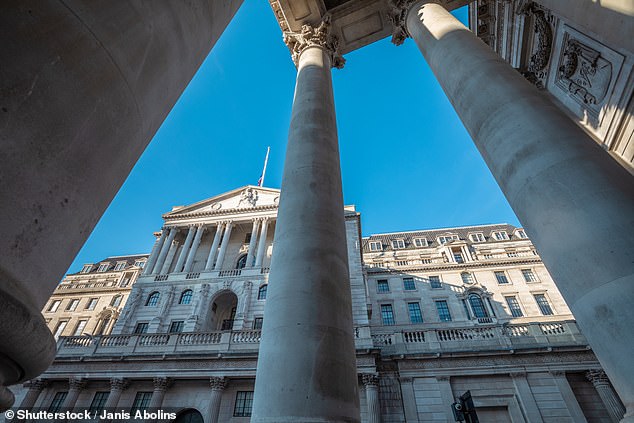
Pause: The central bank held interest rates at 4% again today, but a cut is expected next month
What does this mean for mortgage borrowers?
Today’s decision to hold the base rate at 4 per cent will seem like bad news for mortgage borrowers.
However, most borrowers would not have seen an immediate benefit, unless that are on a tracker mortgage that follows the Bank of England’s rate.
Lenders usually base their mortgage rates on predictions for the longer-term trajectory of interest rates, rather than reacting to individual base rate decisions.
Mortgage rates have been falling in recent weeks on predictions of a December rate cut.
HSBC, Barclays, NatWest, Halifax, Santander and Nationwide Building Society have all cut rates over the past fortnight; some more than once.
The cheapest two-year fix for someone moving home with a 40 per cent deposit is currently 3.64 per cent, while the cheapest five-year fix is 3.89 per cent.
Someone buying with a 20 per cent deposit can get a rate as low as 3.88 per cent, while those buying with a 10 per cent deposit can get as low as 4.12 per cent.
On a £200,000 mortgage being repaid over a 25 year repayment term, a 4.12 per cent rate would equate to paying £1,069 a month.
Today’s decision means rates will stay around the same level, according to Ravesh Patel, director and senior mortgage consultant at broker Reside Mortgages.
‘For mortgage holders, another hold means more short-term stability, though little immediate relief for those on variable or tracker rates,’ he said.
‘Fixed rates are already reflecting expectations of future cuts, and most lenders have gradually been trimming prices over recent weeks.
‘We’re past the peak of mortgage costs, but the pace of improvement will depend heavily on whether the Budget reassures markets about the UK’s economic direction.’

Nicholas Mendes, mortgage technical manager at John Charcol
What next for mortgage rates?
The price of fixed mortgages is heavily influenced by Sonia swap rates – the inter-bank lending rates which are based on expectations of where rates will be at a specific time in the future.
As of today, two-year Sonia swaps are at 3.52 per cent and five-year Sonia swaps are at 3.59 per cent.
This is down from a month ago, when two-year swaps were at 3.7 per cent and five-year swaps were at 3.77 per cent.
Nicholas Mendes, mortgage technical manager at broker John Charcol, said: ‘Lenders have been edging rates down for several weeks, reflecting calmer swap markets and a gentler inflation backdrop.
‘Fixed rates around the mid-three to low four per cents are likely to be the new normal for prime borrowers: sustainable, affordable, and far removed from the panic of 2022.’
What does this mean for your savings?
The base rate affects how much interest savers can earn on their money. In general, savings rates rise when the base rate is rising, and fall when it is falling.
Though the base rate has been held at 4 per cent, savings rates are on a steady downward trajectory.
Since the start of August, just before the base rate was cut to 4 per cent, the average easy access savings rate has fallen from 2.68 per cent to 2.52 per cent and the average easy access Isa rate has fallen from 2.9 per cent to 2.71 per cent.
The best savings rates will probably continue to fall in the coming months.
Those who keep their cash in easy-access accounts are most at risk of rate cuts. The average easy access rate has fallen below 3 per cent, well below the CPI rate of 3.8 per cent.
The best easy-access savings accounts currently pay around 4.3 per cent, while some accounts with restrictions pay up to 5 per cent.
What next for savings rates?
Overall, savings rates will continue on a downward trend, according to rates scrutineer Moneyfacts Compare.
The average savings rate now stands at 3.42 per cent, down 0.29 year on year. It was last above 4 per cent in January 2024 when it stood at 4.04 per cent.
James Blower, founder of savings website The Savings Guru said: ‘Current savings rates are significantly higher than they should be for a 4 per cent base rate.
‘If the base rate falls to 3.5 per by spring 2026 it is forecast that easy-access rates will fall below 4 per cent for the first time since the summer of 2023, while fixed-rate bonds will fall to just above 4 per cent.’
The best one-year fixed-rate bond currently pays 4.41 per cent. This is down from a high of 6.2 per cent in October 2023.
The best easy-access account pays 4.3 per cent which is down from a peak of 5.2 per cent in October 2023.
What should savers do now?
Savers should keep a close eye on their savings, whether they are stashed in an easy-access account, fixed-rate account or an Isa.
If your money is earning interest at a rate of less than the rate of consumer price inflation, 3.8 per cent, you should consider moving it to an account paying a better rate.
James Blower said: ‘This is still a great time for savers to lock away their savings in comparison with where rates are likely to be later this year and in to 2026.’
Savers are also advised to use cash Isas, as it is feared the amount savers can stash in these accounts tax-free could be slashed in half to £10,000 per year at the upcoming Budget.
Rachel Springall of Moneyfacts Compare added: ‘It would be unwise to not make use of the cash Isa allowance.’
Best savings rates and how to find them
The best easy-access savings accounts with no restrictions pay 4.3 per cent.
Coventry Building Society has an easy-access deal paying 4.3 per cent. Someone putting £10,000 in this account could expect to earn £430 in interest after a year, if the rate remained the same.
Those with cash they won’t immediately need over the next year or two should consider fixed-rate savings.
The best one-year deal is offered by DF Capital and pays 4.41 per cent. A saver putting £10,000 in this account will earn a guaranteed £441 interest over one year. It comes with full protection under the Financial Services Compensation Scheme up to £85,000 per person.
GB Bank is offering 4.4 per cent, while JN Bank is paying 4.38 per cent. All offer FSCS protection.
The best two-year bond pays 4.39 per cent and comes from JN Bank.
Oxbury Bank offers the best three-year bond which pays 4.4 per cent and JN Bank has the best five-year deal paying 4.4 per cent.
Savers should strongly consider using a cash Isa to protect the interest they earn from being taxed.
The best cash Isa currently comes from Trading 212* which pays 4.53 per cent.
SAVE MONEY, MAKE MONEY

Sipp cashback
Sipp cashback
£200 when you deposit or transfer £15,000

4.53% cash Isa
4.53% cash Isa
Trading 212: 0.68% fixed 12-month bonus

£20 off motoring
£20 off motoring
This is Money Motoring Club voucher

Free shares bundle
Free shares bundle
Get free UK shares worth up to £200

4.45% Isa with bonus
4.45% Isa with bonus
Now with no penalty for withdrawals
Affiliate links: If you take out a product This is Money may earn a commission. These deals are chosen by our editorial team, as we think they are worth highlighting. This does not affect our editorial independence. Terms and conditions apply on all offers.
#Bank #England #holds #interest #rates #means #mortgage #savings