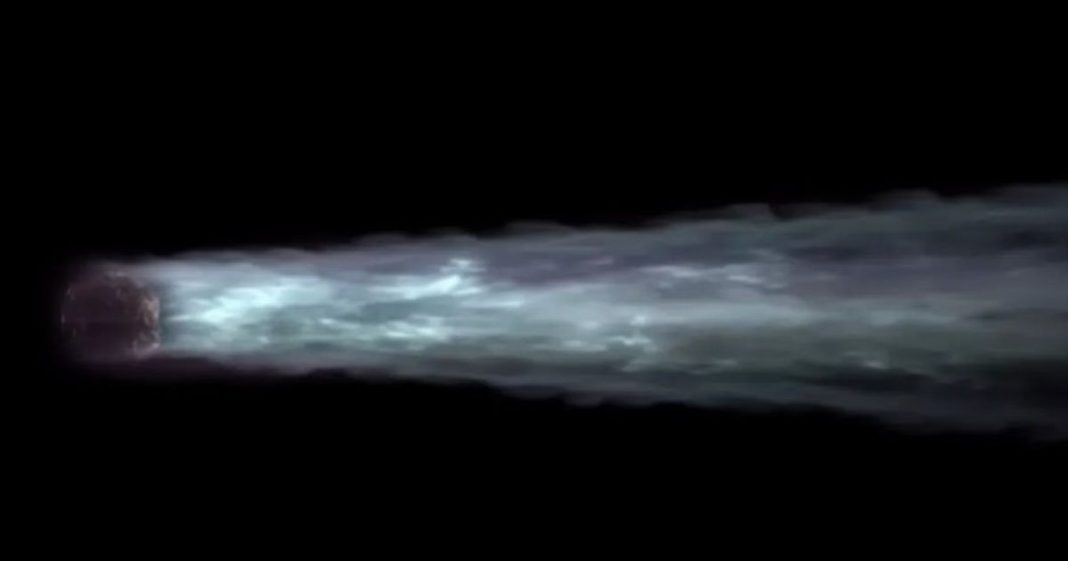

A Harvard expert fears 3I/ATLAS, the mysterious interstellar object hurtling through our solar system, could be ‘an artificial alien probe’ that global agencies need to work out how to tackle fast
Avi Loeb, a physicist sounding the alarm about a bizarre visitor from deep space, warns it may have alien origins and trigger a globally significant “black swan event”. The Manhattan-sized comet has baffled astrophysicists with a host of weird features, including its incredible size and speed.
But a Japanese-released clip now appears to show a “large vessel” associated with the object. A separate social post suggests NASA has “quietly activated” its planetary defence network.
But the unverified new footage has fuelled feverish speculation around the globe. Loeb, the head of Harvard’s Galileo Project, has already outlined “ten anomalies” that suggest the object isn’t a purely natural comet.
Adding to this, Loeb has warned “we’re screwed” if this object comes from a more technologically advanced civilisation. 3I/ATLAS, he says, could represent a “black swan event”. In layman’s terms – a rare, high-impact occurrence that is unpredictable but globally significant.
Global agencies must stay alert and consider strategies to employ should the comet reveal an artificial origin, he says.
Loeb has been warning officials to get ready for mysterious extra terrestrial visitors for months to avoid being “screwed over” – but several have denied his claims.
He further suggests the object’s incoming direction is suspiciously close, within nine degrees, to the 1977 “Wow! Signal” that remains unexplained. This refers to a powerful, narrowband radio signal detected in 1977 by the Big Ear radio telescope. It lasted 72 seconds and had characteristics suggesting it came from an extraterrestrial intelligence.
But many researchers stress that spectroscopic and observational data support a natural, albeit highly unusual, origin. The odd trajectory and chemical composition, they say, don’t prove it’s from aliens.
3I/ATLAS was discovered by the ATLAS telescope system on 1 July 2025. It was classed as “interstellar” because its trajectory showed that it’s not gravitationally bound to our own solar system.
After passing closest to the sun around 29–30 October, the mystery object will come closest to Earth on about 19 December, when it will be about 270 million km away.
Spectroscopic studies have fascinated boffins, showing a gas cloud rich in carbon dioxide and low in water. The object then unexpectedly brightened dramatically and got distinctly bluer than the sun.
Some researchers have think the comet may be as ancient as 7 billion years old.
NASA and the International Asteroid Warning Network (IAWN) have deepened the mystery by reportedly starting an observation campaign. This might be the first time an interstellar object like 3I/ATLAS has been monitored this way.
That said, NASA has confirmed that 3I/ATLAS poses no immediate threat to Earth.
IAWN aims to improve how it tracks and measures small bodies and to test global planetary defence. The comet will remain hidden while near the sun but should re-emerge by early December. Scientists hope to carefully track its trajectory and brightness to see if it follows a natural path or makes any inexplicable changes.
The Jet Propulsion Laboratory has already found signs of “non-gravitational acceleration”, a kick that cannot be explained by the sun’s gravity alone.
For the latest breaking news and stories from across the globe from the Daily Star, sign up for our newsletters.
#Professor #warns #screwed #mysterious #alien #spaceship #3IATLAS #reaches #Earth