
Colliding with an animal on the road can be a frightening as well as upsetting ordeal.
But if you do unfortunately injure or kill the creature, do you know which animals you are legally obliged to report to police?
A new poll by AA Accident Assist has found that four in five drivers know they should inform the authorities if they’ve killed a horse, but only half are aware they need to do the same following a collision with a goat.
Similarly, two in five are unaware of the legal requirement to report incidents involving pigs, mules and asses (donkeys).
The poll of almost 13,500 UK motorists also revealed that drivers believe the law demands they report the death of other animals they strike on the road when they are not required to do so.
Half incorrectly believed they need to report deer strikes, which are said to be up a third in the last three years.

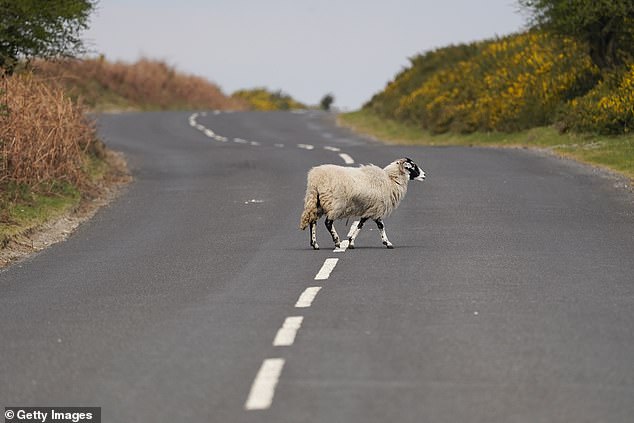
Hit an animal on the road? Do you know which ones you legally need to report to police? AA Accident Assist polled 13,500 drivers and found plenty of confusion amongst motorists
A quarter wrongly said they need to inform the police about incidents involving cats.
Other animals drivers thought needed to be legally reported included; badgers (19 per cent), beavers (15 per cent), llamas (44 per cent), red squirrels (10 per cent) and hedgehogs (6 per cent).
The law surrounding what is a reportable incident are set out in rule 286 of The Highway Code.
This states that any collision involving an animal should be reported and refers drivers to Section 170 of The Road Traffic Act 1988.
It is in this section where the definition of animal is given as ‘horse, cattle, ass, mule, sheep, pig, goat or dog’.
In addition, it clarifies that incidents need to be reported to the police as soon as possible, or at least within 24 hours.

Cattle are among the animals section 170 of The Road Traffic Act 1988 states must be reported to police if you strike one in your vehicle on the road
In the past, there have been several requests for cats to be added to the list, but this was refused in 2022 with the Government arguing that the legislation was based on whether the animal could be defined as a ‘working animal’ rather than a domestic pet.
The AA recommends that collisions involving an animal not specified within the Act should at the least be reported to the local roads’ authority, especially if the animal has died or is on the carriageway.
Similarly, notification of domestic pets, such as cats, should use local veterinary surgeries so owners could be told of their loss.
Tim Rankin, managing director of AA Accident Assist, said; ‘All animals are created equal, until they are involved in a car crash. Then the law is very strict about what should and shouldn’t be reported.
‘While there is often debate about what drivers should do to comply with the law, our affinity as a nation of animal lovers means nobody likes seeing roadkill on our streets.
‘What is clear is that drivers are willing to consider reporting a wide range of animals if they have the misfortune to hit them.
‘Contacting the authority responsible for maintaining the road if they see a dead animal on the road is the least people can do.
‘Similarly, hitting domestic pets not outlined within the law should be reported so owners can be informed.’
Earlier this year, the breakdown provider revealed that deer collisions have increased by 34 per cent since 2021.
It said 1,419 deer were hit by AA members in 2024, compared to 1,054 three years earlier.
Its records show a steady annual rise in deer strikes, with 1,197 deer collisions in 2022 and 1,304 in 2023.
And as on the end of August this year, there have already been more than 1,000 collisions involving vehicles and deer on UK roads.
Similarly, the annual rutting season which runs between September and November have also seen increases. Over the same 2021 to 2024 period, AA Accident Assist has seen a 41 per cent rise in single vehicle deer collisions (195 in 2021 compared to 276 in 2024).
#Collided #animal #road #legally #report #police