
Consumer advocacy group Choice has found multiple children’s toys bought from major online retailers have failed to meet Australia’s mandatory button battery safety standards.
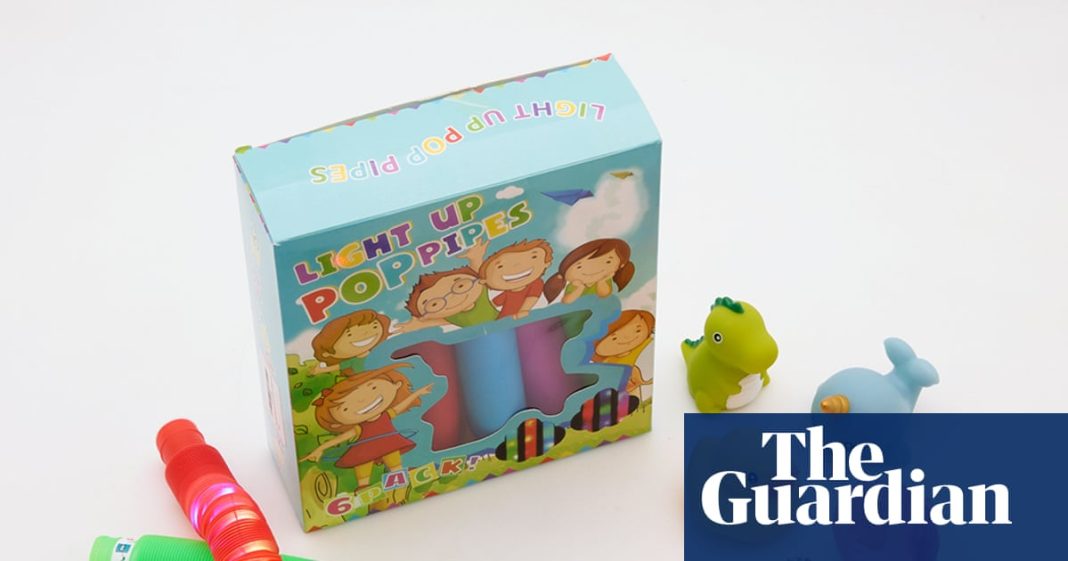
Seventeen out of 24 children’s toys bought from Shein, AliExpress, eBay and Amazon – including a fidget spinner, bath toys and a light-up mouthguard – failed Choice’s product safety testing.
Safety failures included where batteries were able to be accessed without the use of a tool, such as a screwdriver, and the absence of safety alerts or warning statements.
So what are the national safety standards on children’s toys? And how can Australian families know which toys are safe?
Which toys failed the safety standards?
Products that failed Choice’s testing included an electronic writing pad, toy watch, video game and plastic piece, all bought from AliExpress.
Shein’s failed products included slatted glasses, lighted jelly rings, a satin scrunchie, a spin top with launcher, and keyboard button chain.
Amazon had three items, including bath toys, bendy tubes and a keychain, while an eBay-bought fidget spinner, gloves, toy torch, glowing mouthguard and shoes breached regulations, according to Choice.
AliExpress, Amazon, eBay and Shein removed the items from sale in response to the findings.
“We have further expanded our review to identify and remove any similar products that may violate our policies,” said a spokesperson from AliExpress.
A Shein spokesperson said all its vendors are required to comply with Shein’s code of conduct and must abide by the relevant laws and regulations of the countries they operate in. This is similar to Amazon’s policy that all products offered in store comply with applicable laws, regulations and Amazon policies, a spokesperson said.
A spokesperson from eBay said the online marketplace works with the Australian Competition and Consumer Commission (ACCC), product safety regulators and with consumer organisations such as Choice “to swiftly remove reported unsafe items from our global sites”.
Choice also bought two other toys from Amazon and five products from Kogan, which passed safety testing.
Why are button batteries so dangerous?
In Australia, three children have died since 2013 as a result of ingesting button batteries: four-year-old Summer Steer, 14-month-old Isabella Reese and three-year-old Brittney Conway.
In 2020, the ACCC estimated one child a month is seriously injured after swallowing or inserting a button battery. When a battery is swallowed, a chemical reaction occurs that burns through tissue and seriously injures vital organs, according to the ACCC.
“Button batteries can cause catastrophic injuries within hours if swallowed, so it is highly concerning to see products like this continue to be sold,” said Choice’s director of campaigns, Rosie Thomas.
The consumer advocacy group is calling for stronger product safety laws to make it illegal for all companies to sell unsafe products.
What are the rules for toys with button batteries?
In December 2020, the Australian government introduced safety and information standards for button/coin batteries and consumer goods that contain the small, circular single cell batteries; these standards became mandatory for consumer goods from June 2022. The ACCC guide for consumers and businesses applies to consumer products in Australia at any stage in the supply chain – including secondhand goods.
The standards require that button batteries be secured in a compartment that requires a tool to open. Choice found a number of products tested failed to comply with the standard.
“We found a number of them where all it would take is dropping the product on the ground and the battery could fall out,” Thomas said. Choice reported the products to the ACCC.
Manufacturers selling products containing button batteries in Australia are required to secure battery compartments to prevent children from accessing them. They also have to undergo their own testing to make sure batteries are secured and include warnings and emergency advice on packaging about the dangers of button batteries, Choice said.
How can parents ensure their children’s toys are safe?
“Our advice for any new gifts or toys you might be considering purchasing is to avoid the cheap online marketplaces – especially for toys and baby products,” Thomas said.
If parents or carers are concerned about products that contain button batteries, such as toys they have bought secondhand, check how secure the battery compartment is, Thomas said. “If it’s secured with screws that is likely to be a safer product, but if those screws can be removed and taken away from the product there’s a risk there that when you replace the battery you might lose the screws, in which case the battery compartment is no longer secure,” she said.
Because mandatory standards only came into effect a few years ago, Thomas also recommends people check older toys as they likely do not comply.
“You can do a simple drop test yourself to see if the compartment stays closed when you drop the product and so that will give you some level of comfort about whether this might be a safe product,” she said.
“The other thing to do is to try and avoid button battery products altogether.”
Choice said many manufacturers prefer traditional AA and AAA batteries in toys and they are a safer option.
What about other recalled toys?
Last week, the ACCC issued a recall for several play sand products sold at retailers including Officeworks, Kmart and Target. The consumer regulator recalled several children’s sand products because they could contain asbestos, prompting dozens of schools around the country to close for assessment and cleaning.
Official advice is that the risk to children exposed to any of the colourful sand products is very low.
Thomas said: “If you happen to have it in your house the advice is to seal it up and dispose of it following the official guidance for disposal of asbestos waste.
“But I think the broader point is that the disruption and the alarm that’s been caused by the recall really highlights the challenges when unsafe products reach consumers. It’s not straightforward to recall things or get them out of people’s houses or schools, and that’s exactly why we need to ensure our product safety laws are as strong as possible to stop unsafe products reaching consumers.”
Thomas also advises people keep an eye on the ACCC’s product safety website, where details about recalls or banned products are published. In the past 12 months, the ACCC has listed 49 recalled toys, 20 of which were related to unsafe button battery components.
“But really it shouldn’t be up to parents to spot an unsafe product. Our system and laws should make sure that the businesses selling these products have to make sure they’re safe.”