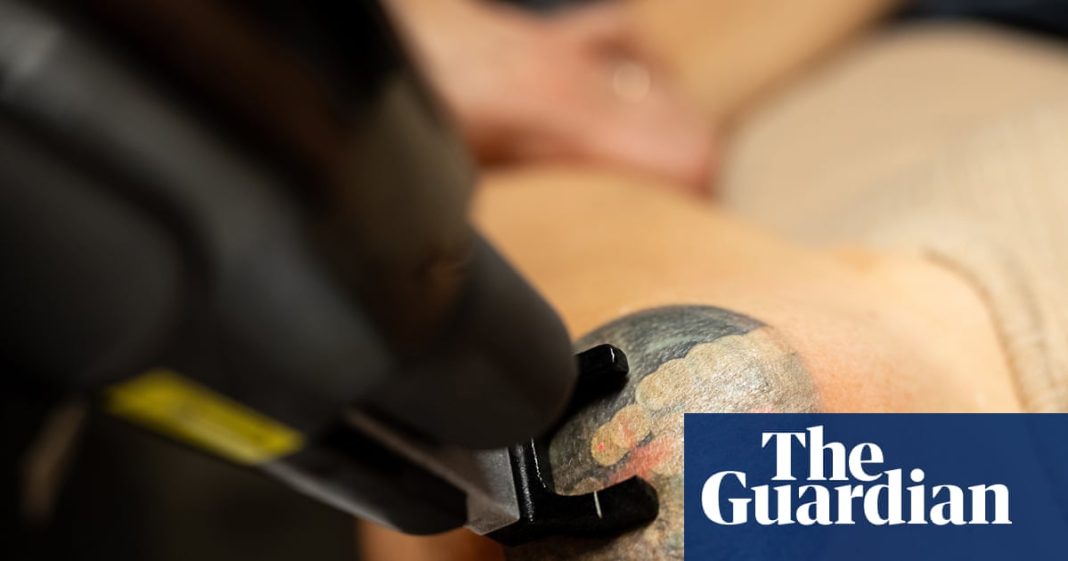

A former Nazi who regrets his swastika tattoo. A refugee who was “branded” as someone’s property. A woman coerced into inking her body by an abusive partner.
Australia’s tattoo removal industry has almost tripled in recent years and most services still involve removing an ex-partner’s name or a cartoon that someone has outgrown. But many are also done to remove Nazi symbols, gang signs, racist messages and more.
And when people can’t afford the expensive and lengthy process, some removal studios are helping out.
Amanda McKinnon, director of LaserTat, says clients would share their tattoo stories with her but sometimes couldn’t afford to pay for the laser treatment. So LaserTat started providing free removals through its Fresh Start program.
“I would feel like ‘this person absolutely needs tattoo removal for them to move forward with their life’,” she says.
“A young girl, a migrant, she was only 17 or 18 and she had a number that was on her … it was a way to brand her. We were able to remove that tattoo for her, so it’s not a reminder of her past experience.
“It can be life-changing for people to not have to look at that same tattoo, and to be reminded of that, day in and day out.”
In another case, Fresh Start treated a woman who was coerced into getting “something really offensive” inked on her while in an abusive relationship.
“We see a lot of women that have been in the DV situation,” McKinnon says. “We see people out of prison that have hand, face and neck tattoos, we help them rehabilitate by taking them off.
“We also remove any medical tattoos, like radiation marks … or iron stains from infusions.”
There has been an increase in people wanting Nazi symbols removed since they were outlawed, she says – WA bikie Dayne Brajkovich was recently fined $500 for having a swastika tattooed on his chin.
Even before Nazi symbols were banned from public display, neo-Nazis co-opted a range of other symbols to signal their allegiance to white supremacist ideas — symbols which people often now want removed.
Sign up: AU Breaking News email
Complete tattoo removal can take up to 12 painful laser treatments, depending on the age of the art and the ink used. Fewer are required for “fades” that are then covered up with another tattoo.
Removery has now dealt with more than 300 tattoos through its philanthropic project, Ink-nitiative. Jules Van de Leur, the people director for Removery’s Australian branches, says it was “developed as an opportunity to give back to people that want to change their lives”.
“They might have been incarcerated or with a gang, in sex trafficking or an abusive relationship. We have worked with people who no longer identify with the statement they were making and want to move forward,” she says.
“We give them an opportunity to turn their lives around.”
She says the application process to determine people’s motives can be challenging but says “you really do just have to lean into the fact that everyone deserves a second chance”.
Mike Anderson, the founder of Think Again Tattoo Removal, also offers free removals for racist or hate-based tattoos through his Chance for Change program. He says it’s hard to be sure people are doing it for the right reasons, but that he’s “doing it for the kids”.
“No doubt we get some people who selfishly come in still holding those views but they don’t want to be judged,” he says.
“But we’re not targeting them, we’re targeting the next generation, because it normalises it.”
He sees outlaw motorcycle gang, white power, black power, and Hitler tattoos and says the number of swastikas he sees is “way bigger than you would imagine”, but that he hasn’t specifically seen an increase since the laws came in.
His theory is people might worry they will get in trouble just for having the symbols.
Robyn, a client of the US branch of Removery and a survivor of domestic violence, right-wing extremism and white supremacism, told her story on the company’s website.
After a traumatic childhood and other traumas she had “two years of absolute horror” with a skinhead who tattooed her.
Though she managed to leave that life, she felt a deep shame about her remaining tattoos and decided to get them removed.
“I just really felt like I … just had to get them off me. I’ve wanted them off for many years,” she says.
She says she gets her nine tattoos all treated in one session. “I take no breaks,” she says.
“I’m like ‘get it done’. It fucking hurts. But get it done.”