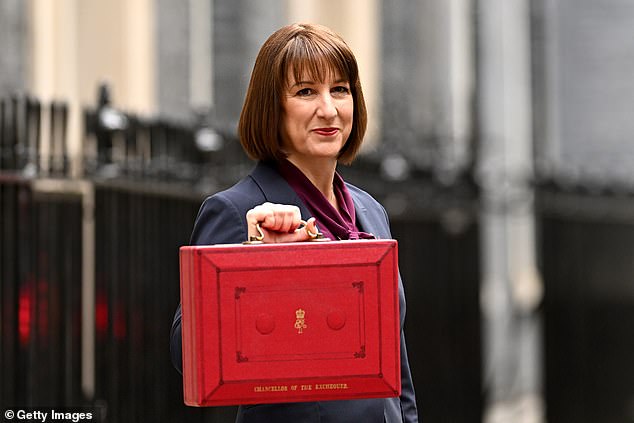

It’s nearly time to discover what horrors the Chancellor of the Exchequer has in store for our savings and household finances.
If commentators across the political divide have read the runes right, Rachel Reeves’ Budget will be short on glee and long on financial pain for a majority of Money Mail readers.
Although there will be welcome measures aimed at combating the cost of living crisis, tomorrow’s Budget will herald a vicious financial assault on those of us who strive valiantly to better ourselves through a mix of hard work and thrift.
In short, the expected £30billion tax grab is likely to be as devastating to the finances of middle class households as the National Insurance attack was on UK businesses in last year’s Budget.
Whether it’s our home, savings, pensions, or investments, all will be smothered in a thick coating of extra taxes to pay for Ms Reeves’ inability (refusal) to keep a lid on welfare spending (north of £300billion and rising exponentially).
For many, the Budget will be a bitter pill to swallow. But please don’t despair or bury your head under the settee cushion as Ms Reeves spouts forth. Fight back.
Here, Money Mail identifies the key attacks on your wealth likely to feature in tomorrow’s Budget.
More importantly, we look at how you can mitigate their financial pain: almost as soon as the Chancellor sits down from delivering her second (and probably last ever) Budget – although Ms Reeves insists she is here to stay.

If commentators across the political divide have read the runes right, Rachel Reeves’ Budget will be short on glee and long on financial pain for a majority of Money Mail readers, writes Jeff Prestridge
Pensions
Saving for retirement via a tax-friendly pension will become more difficult as a result of tomorrow’s Budget:
Reason 1: An attack on ‘salary sacrifice’ company pensions will spearhead the assault.
Although Ms Reeves will present it as an essential closing of an expensive tax loophole, the curbing of such schemes will have adverse financial implications for millions of workers who use them to save for retirement.
One in three private sector employees currently save into them, but Reeves is keen to recoup a big chunk of the annual £4.1billion lost in National Insurance (NI) revenue as a result of the clever way they are set up.
In basic terms, a worker gives up (sacrifices) a portion of salary and in return the employer pays an equivalent sum into their pension pot.
By doing this, the worker pays less NI on a salary reduced by the sacrifice, resulting in more take home pay at the end of the month.
The employer also benefits from a lower NI bill because they don’t pay it on the salary diverted into the worker’s pension.
If such pension plans are either restricted in the Budget (for example, through a limit on the amount of salary that can be sacrificed) or done away with altogether, workers will see a cut in take home pay.

Saving for retirement via a tax-friendly pension will become more difficult as a result of tomorrow’s Budget
Some would likely respond by trimming back their pension payments.
Employers, still reeling from the higher NI costs imposed on them in last year’s Budget, could make matters worse by reducing the employer contributions they make into workers’ pension funds.
How to react: It is unlikely any restriction on salary sacrifice pensions will come in until (at the earliest) the start of the new tax year in April.
This is primarily because of the time it will take employers and scheme managers to adapt pension funds to any new regime.
So, if you are paying into such an arrangement (check with your employer if you are unsure), there is NO need to panic.
Keep squirrelling money away into your pension and under NO circumstances stop your payments (you’ll regret it in later life).
Indeed, if changes don’t come in until April, consider increasing your ‘sacrifice’ now, thereby boosting your pension funding before the new rules come in.
Speak to your employer or pension scheme administrator if you are keen to do this.
Reason 2: Apart from restrictions on salary sacrifice, look out for any measures (attacks) designed to make it more difficult to fund your pension.
These could include a trimming of the £60,000 annual limit on pension contributions eligible to receive tax relief.
Also, there might be an announcement on reform of tax relief. This could pave the way for the axing of the current system where savers enjoy tax relief on payments according to whether they are a 20, 40 or 45 per cent taxpayer.
In its place could come a flat rate (say 20 or 30 per cent).
How to react: Neither measure would be introduced straight away. If a cut in the annual limit is announced, it would probably come in from the start of the new tax year in April. Any reform to tax relief would take longer.
But if they do get a Budget mention, don’t be distracted. Keep paying in to your pension, irrespective of whether you are a basic, higher, or additional rate of income taxpayer.
And if your financial position allows it, see if you can increase your contributions in the current tax year. The earlier – and the more – you pay in to your pension, the greater the chance you give yourself of ending up with a fund sufficient to see you through retirement.
Reason 3: We know the Budget will not include a cut in the tax-free cash that people can currently take from their pension fund from age 55 (typically 25 per cent, subject to a cap of £268,275).
This was belatedly ruled out by the Treasury earlier this month, but not before tens of thousands of people had taken the cash thinking a stricter cap (£100,000) would be introduced.
Yet it doesn’t preclude the Chancellor from mentioning pension tax-free cash in the Budget. For example, she could announce a review of the arrangement, paving the way for a cut before Labour’s official term in office comes to an end in 2029.
How to react: If such a review is included in the Budget, and you are approaching that time in your life when accessing your pension is a consideration, note down all the details.
And then be sure to speak to a financial adviser about the best way forward: not just in terms of avoiding any future clampdown but when taking cash makes best financial (and tax) sense for you.
Isas
The Chancellor will confirm an overhaul of Individual Savings Accounts (Isas) which will result in a clampdown on both young and old using these wrappers to shield cash from tax.
A reduction in the annual Cash Isa allowance from £20,000 to £12,000 is a dead cert. So, for those wanting to utilise the full £20,000 Isa allowance in the future, they will have to use the tax shield to invest in stocks and shares as well as save (some already do this).

A reduction in the annual Cash Isa allowance from £20,000 to £12,000 is a dead cert in tomorrow’s Budget
How to react: Any changes to Isa rules will likely kick in from the start of the new tax year in April.
So, for those who believe cash is king, it’s time to use as much of the current (last ever) £20,000 cash Isa allowance as you possibly can.
If you or your partner has cash sitting in non-Isa accounts while simultaneously having any unused cash Isa allowance for this tax year, it’s time to transfer enough money to take full advantage of the £20,000 allowance (£40,000 per couple).
Do this even if your taxable savings are protected by the annual tax-free personal savings allowance (£1,000 for basic rate taxpayers, £500 for higher rate taxpayers).
Money inside a cash Isa is protected from tax irrespective of what happens to savings rates – and whatever rate of income tax you pay.
With Ms Reeves likely to confirm an extension of the income tax threshold freeze until 2030, hundreds of thousands of savers in the next five years are going to see their personal savings allowance either halved (as they become 40 per cent taxpayers) or taken from them (as they become 45 per cent taxpayers).
Investing
Building investment wealth outside of Isas and pensions will become harder from t if taxes on both dividend income and capital gains on share sales notch up as expected.
Most Labour MPs are keen to align these taxes with those on income.
It took the first step on this journey last year when the Chancellor hiked capital gains tax (CGT) rates on share disposals from 10 to 18 per cent for basic rate taxpayers – and 20 to 24 per cent for higher rate taxpayers.
These taxes are charged on share sales above the annual exemption allowance of £3,000.
Taxes on annual share dividends remained unchanged – at 8.75, 33.75 and 39.35 per cent for basic, higher, and additional rate taxpayers respectively – with the first £500 of dividend income exempt from tax.
Tomorrow’s Budget could represent the second step of the journey with both CGT and dividend tax rates rising. The respective annual tax-free exemptions of £3,000 and £500 might also get a haircut.
How to react: If tax rates are jacked up, they will apply immediately: it’s what happened last year and there is no reason why the Chancellor would change tack.
Any cutbacks on the annual exemptions would kick in from next April.
For investors, the best reaction is to prioritise tax-friendly pensions and stocks and shares Isas. Consider transferring investments held outside these vehicles into them (using processes called bed and Isa and bed and pension).
Also, if you’re married, ensure investments are split between you, enabling you to double up on allowances and tax exemptions.
Other taxes
To fulfil her £30billion tax grab, Ms Reeves will announce a myriad of other tax raising measures.
So, expect more taxes on inherited wealth (or further restrictions on gifting), new ones on property wealth and some unexpected ones (NI on rental income earned by landlords?).
And, as already alluded to, we will pay more tax on our income as tax thresholds are frozen until 2030, dragging more of us into tax or higher tax bands.
How to react: Some of these taxes, for example an annual council tax ‘surcharge’ (mansion tax) on £2million plus homes, are still in creative phase and will not come in for a while (2028 in the case of a mansion tax).
So, there is no need to panic until the detail is published.
Others, sadly, will be largely unavoidable (for example, more of your income drifting into tax territory) while changes to the gifting rules could take many forms, so are hard to predict.
Most likely is a change to ‘potentially exempt transfers’, extending the time such gifts remain potentially liable to inheritance tax from seven to ten years.
And to end on a bit of a high
Ending on some Budget good news, VAT on domestic energy bills looks like it will be scrapped. And for our many long-standing readers, the state pension is going up by an inflation busting 4.8 per cent.
How to react: Rejoice.
#chance #guide #beating #Budget #money #guru #JEFF #PRESTRIDGE #havent #left #late.. #whats #tomorrow #react #Act