
The idea of the sea that I grew up with was associated with sundowners and souped-up cars and skipping classes to sunbathe with the models who took over Cape Town’s beaches each summer. As a student, long nights would end, not infrequently, with a swim at sunrise (until, one morning, the police arrived to remind us that sharks feed at dawn). So it’s hardly surprising that, after moving to Norwich to study in my 20s, the British seaside trips I made felt tepid. Cromer, with its swathe of beige sand sloping into water an almost identical colour, seemed to suggest that over here, land and sea were really not that different from one another. That the sea as I’d known it – with all its ecstatic, annihilating energy – was an unruly part of the Earth whose existence was best disavowed.
It was only several years later, burnt out from a soul-destroying job, that I took a week off and boarded a train to Cornwall. I was 25, poor and suffering from the kind of gastric complaints that often accompany misery. With a pair of shorts, two T-shirts and a raincoat in my backpack, I arrived in St Ives and set off to walk the Cornish coastal path.
On my second day, to my surprise, I was joined by an Iranian philosophy student I’d met at my local cafe – perhaps he was lonely and ill at ease too – and we skirted the cliffs in single file talking Hegel and subsisting almost entirely on the blackberries which burst from the verges demanding to be eaten. Beneath us, the sea shifted between being darkly rageful and a blue so pure that, if you squinted, could be the Mediterranean. By day three, we were sleeping together, and by day five, having suddenly become allergic to each other, I carried on alone.
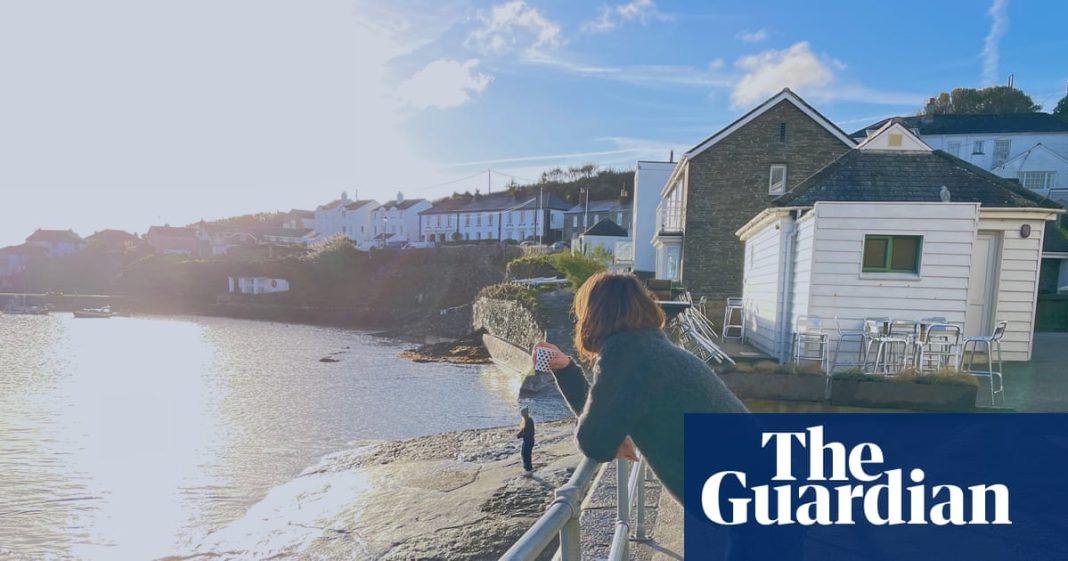
I didn’t discover Portscatho on that trip, but I did discover the pleasures of tracing the Cornish coastline on foot. Which is how, a decade later, coming round the headland of the Roseland peninsula while hulkingly pregnant, I laid eyes – in the next bay – on a group of oddly gentle-looking Georgian houses surrounding a small harbour.
The feeling I had, coming into that village, reminds me of a passage in a Nabokov story, Cloud, Castle, Lake. A bachelor, who’s been forced to go on a communal holiday by the “Bureau of Pleasantrips”, unexpectedly comes upon a configuration of elements – a dark castle overlooking a lake on which a cloud is reflected in its entirety – whose particular arrangement simultaneously reveals and fulfils a longing so deeply buried in himself that, until then, he hadn’t known it existed.
It was late autumn. As the narrow path dropped from the cliffs, the landscape became almost tropical: dry grasses turned into passionflowers. Crepey pink rhododendrons peered from the front gardens of the houses on the outskirts of the village. I remember the clouds that had brooded over the landscape for days suddenly clearing, giving way not to a half-hearted sunshine, but to the kind that makes you want to strip off your clothes and inhibitions and become your true self. In the village square, above a pier, off which a group of children were throwing themselves into the sea, was a pub that spilled on to the pavement, where a group of men sang sea shanties watched by people leaning against the low walls of houses over the road, sipping pints.
Writers, in my experience, prefer disillusionment to transcendence. I, for one, suspected – even as it occurred – that my Cloud, Castle, Lake experience would, on repeat visits, turn out to be false: the product of novelty or pregnancy hormones. And yet, in the decade since – and not a year has passed when I’ve not gone back to Portscatho at least once – it hasn’t lost its sheen.
What does one picturesque seaside village, with its two pubs and its fish and chip shop, its Harbour Club hosting cover bands on Saturday nights, give that another does not? Sometimes, my love for it seems embarrassing. An indictment on my heart. As though, if I were less naive, less needing of tenderness or comfort, I’d give myself over to wilder, more difficult beaches – like Towan Beach, a mile or so further along the coast, whose crescent of empty sand resembles the beaches in New Yorker cartoons where a bearded man washes up to spend eternity eating coconuts.
I should be able to enjoy a wild sea surrounded by nothing but wilderness, rather than a sea, like Portscatho’s, in which one is always a few steps from humanity and the comforts of the low-ceilinged Plume of Feathers, or a chowder cooked by local celebrity chef Simon Stallard (whose latest venture, the Standard Inn, is up the road in Gerrans). Or a grocery shop selling artisanal cheeses and New World wines. Or a gallery with paintings in the style of Georges Braque, instead of the bits of driftwood bric-a-brac and watercolour paintings of boats that wash up in most coastal towns. I ought to join the local wild swimming group for its daily 8am dip without needing the comforts of an espresso from a beachfront coffee bar to warm me afterwards. But, just as ghost stories are best enjoyed from a cosy chair by the fire …
What redeems me, in my own eyes, is my preference for the winter months over the summer ones. I love being in Portscatho when the clocks change, and we’re meant to stay indoors watching whatever’s done well at the Emmys, but are often still on the beach at 5pm when the clear night sky brings out its wares. I love New Year, too, when Stallard cooks up a meal on the slipway – one year it was paella – and everyone gathers for the annual firework display.
I love, best of all, the moment when, turning down the steep road into the village at the end of the long drive from London, I see the Plume, and the two roads extending from either side of it like outstretched arms towards the bay. How the sea, every time I arrive, seems to say: “Here you are, at the edge of the world, you’ve arrived at the end of the place where you’ve carried out your labours, so you can finally relax.”
Katharine Kilalea is the author of OK, Mr Field, published by Faber at £8.99. To support the Guardian, order your copy at guardianbookshop.com. Delivery charges may apply.