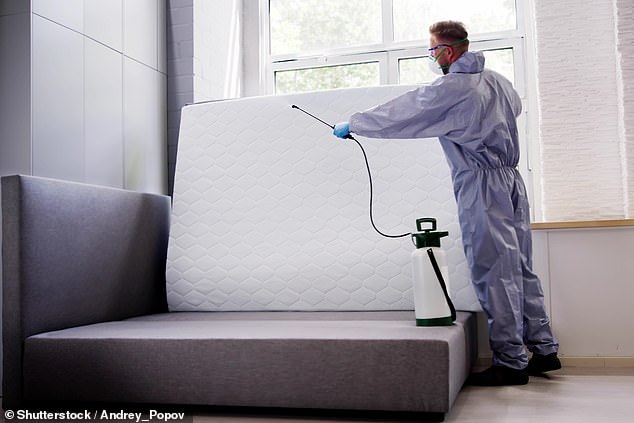

We moved into a rented house a few months ago. It’s on the cheaper side as that’s all we can afford. There are now bedbugs in the property.
What are our rights and how can we get rid of them? We deal with a lettings agency rather than the landlord.
Can we get the landlord to pay and get it sorted? He seems reluctant to do anything to the property.

Problem: A Daily Mail reader wants to know who is responsible for getting rid of a bedbug infestation in a rental property
Jane Denton, of the Daily Mail, replies: Bedbugs are small insects which often live on furniture or bedding. Their bites can be itchy, but do not usually cause other health problems, the NHS says on its website.
According to recent reports, a new ‘super-strong generation of blood sucking’ bedbugs is invading the UK this year. Pest controllers have reported finding it difficult to kill these off with standard chemical treatments.
According to a Freedom of Information request by Direct Line, bedbug infestations saw a 35 per cent jump between 2022 and 2024.
Notify your lettings agency and, if possible, the landlord, immediately by phone and in writing to notify them of the problem.
Be clear about the impact the bedbugs are having on you, your health and the property.
According to Shelter, a landlord must deal with a pest infestation such as bedbugs if it is caused by a repair that they must fix.
The landlord must also make sure your home is fit to live in during the entire tenancy. If pests were there when you moved in, the landlord should sort this out.
If you do not get anywhere with the landlord or lettings agency, contact your local council and tell them about the problem. Request an inspection of your property via the council.
If the pests were triggered by something the landlord had to fix, he will need to pay to get a pest controller out and resolve the problem.
Shelter suggests: ‘Do not withhold your rent. If you pay for pest control and want to take the money off your rent, try to negotiate instead.’
In limited circumstances, it may be determined that you or others in your household may have done something to encourage the pests.
In the interim, consider washing affected bedding or fabrics and clothing on a hot wash and tumble dry on a hot setting for at least 30 minutes.
The NHS also suggests putting affected clothing and bedding in a plastic bag and putting it in the freezer for three or four days
Also, am I am sure you do this already, clean and vacuum regularly – bedbugs are found in both clean and dirty places, but regular cleaning will help you spot them early.
Bedbug infestations can be difficult to get rid out. A professional pest-controller will need to be involved.
James Rhodes, a pest expert at ThermoPest, said: Landlords are responsible for making sure tenants have a safe and habitable place to live.
But in the UK, responsibility for dealing with a bedbug infestation isn’t always clear-cut. It usually depends on how and when the problem began.
If bedbugs were present before you moved in, it is generally the landlord’s duty to resolve the issue, as they must provide a habitable property at the start of a tenancy.
If the infestation develops during the tenancy, and it can be shown that the tenant introduced it, for example through luggage, second-hand furniture, or guests, then the responsibility typically falls on the tenant to arrange and pay for treatment.
In cases where it’s unclear how the infestation started, proving responsibility can be difficult. Many landlords choose to act regardless, especially in blocks of flats where bed bugs may spread between units. Costs may be shared or negotiated in these situations.
Most tenancy agreements include clauses on pest control, and landlords also have a legal duty to keep properties safe.
Local councils can intervene if an infestation makes a home unfit to live in, although tenants may still be charged if they are clearly responsible.
In simple terms, bedbugs are already present when you move in, the landlord will usually be responsible. If they appear during the tenancy, the responsibility is more likely to rest with the tenant.

Be careful: Responsibility for dealing with a bedbug infestation isn’t always clear-cut
What should you do if your landlord doesn’t act quickly?
First, you should report the infestation to your landlord or housing association as soon as possible, ideally in writing.
Keeping a record of all communications is useful, especially if you need to take the matter further later on.
If no action is taken within a reasonable timeframe, you can escalate the issue by contacting your local council or environmental health team. They may be able to put pressure on the landlord or housing provider to act, particularly if the infestation makes the property unsafe.
It is worrying when appropriate action isn’t taken, because the longer a bedbug problem is left untreated, the more disruptive and costly it becomes.
In some cases, tenants have had to replace furniture or even leave their homes temporarily, with expenses running into thousands of pounds. Acting quickly helps limit the stress, disruption and financial impact.
What is the most effective way to get rid of bed bugs?
Bedbugs are not something tenants can realistically tackle on their own. Many people try DIY sprays or cleaning hacks, but unfortunately these methods don’t work.
Bed bugs are one of the hardest pests to eliminate, and the longer they are left untreated, the more they spread.
The only reliable way to get rid of them is through professional extermination. Heat treatment is the most effective approach, usually resolving the issue in just one or two visits.
It uses far fewer chemicals than traditional methods, which is better for both your health and the environment, while the small amount of targeted insecticide ensures that nothing survives, not even the eggs.
If you notice bed bugs, the best step you can take is to report the issue straight away so that professional treatment can be arranged quickly. The sooner it’s dealt with, the easier and cheaper it is to get your home back to normal.
#bedbug #infestation #rental #property #rights