
When fighter jets screamed over downtown Taipei in the early hours of Wednesday morning, it sparked a mild panic among visitors not used to the constant threat of invasion.
Fortunately for them – and for the global economy – China had not finally followed through on its designs on its neighbour.
Instead, it was Taiwan’s air force practising for a show two days later to celebrate the 1911 republican revolutionary uprising that ended millennia of rule by China’s emperors.
But as well as celebratory military parades on streets decked with the national flag, Taiwan’s citizens also witness increasingly aggressive – and often unannounced – ‘military drills’ by Chinese warships and aircraft entering its airspace and coastal waters.
The island nation, which its neighbour across the water views as a renegade province, has lived with the looming danger of invasion for decades, ever since the defeated nationalists, led by Chiang Kai-shek, fled Communist China for Taiwan in 1949.
It is not just the Taiwanese who have reason to fear Chinese aggression, with Beijing’s bellicose rhetoric rising during the reign of Xi Jinping. The surge in demand for artificial intelligence means Taiwan is more vital to the global economic order than ever before, with any invasion likely to trigger one of the biggest economic crises in history.

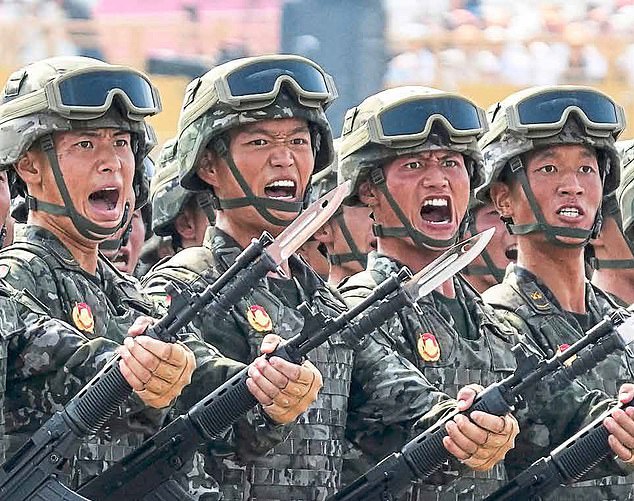
Threat: Chinese troops in Tiananmen Square last month – Beijing has vowed to seize Taiwan in a move that would burst the stock market bubble
Despite its relatively small size, Taiwan dominates global production of semiconductors, tiny computer chips that power mobile phones, cars, aircraft systems, missiles and just about every other electronic device.
Taiwan’s microchip industry accounts for over two-thirds of the global market. Crucially, it makes about 90 per cent of the most advanced chips, which are critical for firms hunting for the computing power needed to create ever more sophisticated AI systems.
This is down to the Taiwan Semiconductor Manufacturing Company (TSMC), a £1.1 trillion chipmaker based in the city of Hsinchu, considered the country’s equivalent to Silicon Valley due to its proliferation of technology and electronics firms.
TSMC is so revered by the Taiwanese it is nicknamed the ‘guardian sacred mountain’, referring to the central mountain range, which protects Taiwan’s more populated western side from typhoons.
One of TSMC’s biggest clients is US computer processor giant Nvidia, the world’s biggest firm, valued at £3.4 trillion. Its boss, Jensen Huang, is Taipei-born.
The leap in demand for advanced chips to feed the rapidly expanding growth of AI is cementing the country’s hegemony, with Taiwan’s semiconductor industry set to produce £158 billion of chips this year.
It has reaped rewards for holders of TSMC shares, which have tripled in the past five years, though this is dwarfed by Nvidia’s huge ascent in the same period.
But as the appetite for advanced chips grows, so does the risk that any disruption to Taiwan’s factories could bring to the sector, and with it the global economy.
‘If China invades Taiwan the modern world economy will be finished for ever,’ said Francois Wu, Taiwan’s deputy foreign minister.
An invasion – which the US has vowed to repel with force – or even a naval blockade that restricted Taiwan’s exports, would slam the brakes on the AI revolution, potentially causing a stock market meltdown similar to the dotcom crash of the early 2000s.
Yet Wu says it is unrealistic to think Taiwan’s industry could be easily relocated or replaced.
‘Moving the factories to another country will not solve the problem. And it is naive to think we will abandon the semiconductor industry under pressure from abroad.

‘We will not weaponise our chip industry, but if China invades the sector will either be completely destroyed or occupied by Beijing.’
While officials and local analysts are sometimes coy to say the country’s chip sector forms a core part of its national security strategy, their desire to guard its most valuable capabilities is undeniable. This month, vice-premier Cheng Li-chiun said Taiwan would ‘not agree’ to produce half its chips in the US despite pressure from Donald Trump, who has accused it of ‘stealing’ US chip business.
Hsien-Ming Lien at Taiwan’s Chung-Hua Institution for Economic Research said TSMC’s efforts to build new chip factories in the US had run into trouble.
‘In Taiwan, TSMC’s workforce act like A&E doctors,’ he said. ‘They come back to the factory at any time to try and fix problems. This is not common in the US.
‘This cultural difference is difficult to overcome. It’s a challenge to find workers so dedicated.’
Any move would also face fierce resistance from the local population, many of whom view the sector as part of its national identity and a crucial factor in its transformation into an advanced economy.
In a speech at the national day celebrations, Taiwan’s president William Lai said the industry was ‘forged by decades of combined efforts’ and pledged to protect the country’s ‘valuable assets’.
Taiwan, like many long-time American allies, now finds itself seeking other partners on the world stage to support its position against Beijing’s belligerence.
It was unable to escape Trump’s tariff barrage, with the US slapping a 20 per cent levy on exports.
Trump’s erratic foreign policy has also thrown into doubt the presumption that the US would use its military to protect Taiwan.
Like most countries, the UK does not officially consider Taiwan to be an independent nation – mainly to avoid invoking the ire of Beijing.
But as the AI revolution makes Taiwan’s chip industry more vital to the health of the global stock market and wider economy, many nations may find themselves having to pick sides sooner than they expect. And traders, fearful of a stock market bubble bursting, are watching Taiwan more closely too.
They are acutely aware that the sound heralding the next market meltdown may not be the opening bell on Wall Street, but the roar of Chinese fighter jets over the skies of Taipei.
DIY INVESTING PLATFORMS

AJ Bell
AJ Bell
Easy investing and ready-made portfolios

Hargreaves Lansdown
Hargreaves Lansdown
Free fund dealing and investment ideas

interactive investor
interactive investor
Flat-fee investing from £4.99 per month

InvestEngine
InvestEngine
Account and trading fee-free ETF investing

Trading 212
Trading 212
Free share dealing and no account fee
Affiliate links: If you take out a product This is Money may earn a commission. These deals are chosen by our editorial team, as we think they are worth highlighting. This does not affect our editorial independence.
Compare the best investing account for you
#boom #puts #Taiwans #semiconductor #sector #centre #worlds #biggest #flashpoint