
A fifth of British homeowners have seen the value of their property rise by 20 per cent or more in the last two decades, according to new data.
Areas in London and Greater Manchester topped the list of locations which have seen super-sized price rises, according to estate agent Savills.
Unlike most house price indexes, these figures are adjusted for inflation meaning that they reflect the increase in value in real terms.
The biggest winners are homeowners in Blackley and Middleton South in Greater Manchester, which have seen their properties rise by a huge 71 per cent on average since 2005 to reach £219,037.
While some places have seen stratospheric rises even with inflation taken into account, the research shows that average house price growth has been more muted.

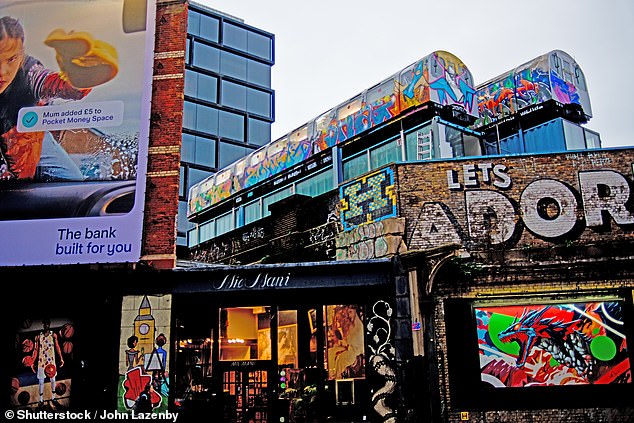
Big riser: London’s Shoreditch is one of the areas to have made big house price gains over the last two decades, according to Savills’ inflation-adjusted figures
Savills’ analysis reveals that while house prices have risen by an average of 95 per cent across Britain over the past 20 years, this averages at less than 9 per cent when adjusted for inflation.
And there are also areas where prices have gone down substantially in real terms.
Three locations in the North West have seen drops of more than 20 per cent, while parts of the North East, Yorkshire and the Humber and Wales have also been hit.
In over a quarter (26 per cent) of the country, prices are lower than they were in 2025 on an inflation-adjusted basis, Savills says.
London tails off as Manchester grows
While the capital is clearly a winner in Savills’ index, the estate agent said the bulk of growth in the past two decades happened between 2005 and 2015.
Since then, it said, prices have fallen on an inflation-adjusted basis in 44 of London’s 75 parliamentary constituencies.
Over the 20 years, central London’s Kensington and Bayswater has seen prices grow by 67 per cent, the same as Walthamstow in the North East.
However, values in Kensington have fallen 21 per cent in the past ten years as appetite for central London property has wavered.
Gentrification hotspots such as Hackney North and Stoke Newington (62 per cent) and Hackney South and Shoreditch (57 per cent) and Peckham (46 per cent) also featured highly.
Lucian Cook, head of residential research at Savills, said: ‘The areas that have seen the strongest real house price growth over the past 20 years are dominated by London locations, which experienced robust growth up until 2015.
‘However, growth has reached an affordability ceiling over the past decade, with average incomes unable to keep pace.’
In Greater Manchester, Blackley and Middleton South is a residential district to the north of the city centre which offers affordable properties compared to other neighbouring districts. It includes the suburbs of Blackley and Crumpsall and is home to Heaton Park.
In contrast to London, house price growth has accelerated there in the last decade along with much of Greater Manchester. Prices in the constituency went up 51 per cent between 2015 and 2025 alone.
Cook said: ‘Having seen lower than average price growth in the 20 years to 2015, it was well placed to capitalise on the UK entering the second half of its housing market cycle and the resurgence of Manchester in particular.’
Elsewhere, Gorton and Denton in Greater Manchester saw prices go up 49 per cent to £234,123 and Bristol East homes rose 44 per cent to £342,586 on average.
The ward includes up-and-coming Levenshulme, popular with first-time buyers.
| Location | House price first six months 2025 | 05 to 15 increase (adjusted for inflation) | 15 to 25 increase (adjusted for inflation) | 05 to 25 increase (adjusted for inflation) |
|---|---|---|---|---|
| Blackley and Middleton South | 219,037 | 13.8% | 49.9% | 70.5% |
| Kensington and Bayswater | 1,848,404 | 110.7% | -20.6% | 67.3% |
| Walthamstow | 563,109 | 49.6% | 11.4% | 66.6% |
| Tottenham | 569,745 | 49.3% | 8.9% | 62.6% |
| Hackney North and Stoke Newington | 690,566 | 70.4% | -5.2% | 61.5% |
| Lewisham West and East Dulwich | 641,063 | 62.5% | -1.0% | 60.8% |
| Hackney South and Shoreditch | 650,934 | 84.7% | -14.8% | 57.4% |
| Lewisham North | 565,861 | 55.5% | 0.8% | 56.8% |
| Leyton and Wanstead | 608,660 | 42.6% | 6.8% | 52.2% |
| Hampstead and Highgate | 1,266,489 | 71.6% | -13.2% | 48.9% |
| Gorton and Denton | 234,123 | 1.0% | 47.0% | 48.5% |
| Cities of London and Westminster | 1,442,199 | 96.8% | -25.4% | 46.9% |
| Hornsey and Friern Barnet | 778,758 | 51.3% | -3.0% | 46.7% |
| Peckham | 570,643 | 52.0% | -3.6% | 46.5% |
| Bristol East | 342,586 | 9.4% | 31.6% | 44.0% |
| Lewisham East | 492,661 | 36.1% | 5.2% | 43.2% |
| Ealing Southall | 618,704 | 44.6% | -1.8% | 42.0% |
| Islington North | 734,576 | 76.6% | -19.8% | 41.6% |
| Mitcham and Morden | 491,195 | 34.0% | 4.9% | 40.6% |
| Holborn and St Pancras | 882,499 | 71.1% | -18.5% | 39.5% |
| Location | House price first six months 2025 | 05 to 15 increase (adjusted for inflation) | 15 to 25 increase (adjusted for inflation) | 05 to 25 increase (adjusted for inflation) |
| Ceredigion Preseli | 251,343 | -13.7% | 1.1% | -12.7% |
| Houghton and Sunderland South | 162,470 | -10.3% | -2.7% | -12.7% |
| Sefton Central | 303,087 | -15.3% | 2.8% | -12.9% |
| Mid and South Pembrokeshire | 236,010 | -11.4% | -1.9% | -13.1% |
| Wrexham | 221,307 | -6.7% | -7.0% | -13.2% |
| Thirsk and Malton | 292,404 | -17.5% | 4.7% | -13.6% |
| Fylde | 274,491 | -16.7% | 3.4% | -13.9% |
| City of Durham | 205,544 | -5.4% | -9.4% | -14.3% |
| Torbay | 253,218 | -9.0% | -6.9% | -15.3% |
| Richmond and Northallerton | 296,010 | -13.1% | -3.1% | -15.8% |
| Blaydon and Consett | 168,431 | -11.9% | -4.9% | -16.2% |
| Leeds Central and Headingley | 256,855 | -28.3% | 16.6% | -16.4% |
| North Durham | 159,186 | -13.5% | -3.5% | -16.5% |
| Aberdeen South | 162,968 | 59.4% | -48.4% | -17.7% |
| Scarborough and Whitby | 224,985 | -17.2% | -1.3% | -18.3% |
| Inverclyde and Renfrewshire West | 156,734 | 0.8% | -19.2% | -18.5% |
| Stockton West | 239,912 | -14.8% | -4.5% | -18.6% |
| Blackpool North and Fleetwood | 178,755 | -23.8% | 4.9% | -20.1% |
| Southport | 240,272 | -26.4% | 6.2% | -21.9% |
| Blackpool South | 144,925 | -26.9% | 3.0% | -24.8% |
| Source: Savills | ||||
Areas that offer a bargain
On the other end of the scale Savills has highlighted places where property values have dropped in real terms over the past 20 years, meaning buyers can pick up homes at keen prices.
All of these areas are in the North of England, Scotland or Wales, with the exception of seaside resort Torbay in Devon.
Deepest in the doldrums is Blackpool South, where homes fell 25 per cent in real terms to £144,923 over the period. They have turned the tide more recently though, going up by 3 per cent between 2015 and 2025.
Other fallers included Southport (22 per cent), Stockton West (19 per cent) and Aberdeen South (18 per cent), with the latter hit by turbulence in the oil industry on which it relies.
Lucian Cook of Savills said house price growth had been muted over the past 20 years.
‘In contrast to the ten years to 2005, when house prices rose by an average of 147 per cent in real terms, real house price growth has been muted and unevenly distributed over the past 20 years,’ he said.
‘Tougher economic conditions heralded the end of inflation-busting housing growth, making it harder for buyers to build up housing wealth, meaning that they have become much more reliant on paying down their mortgage debt.’
#Britains #BIGGEST #house #price #winners #Areas #prices #surged #years