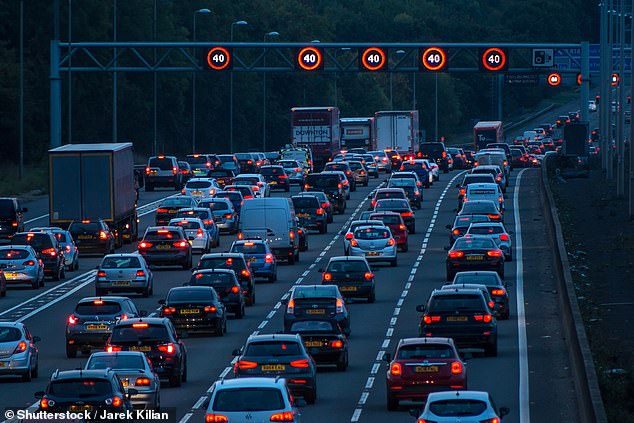

With the clocks due to go back an hour from Sunday, drivers are set to face an evening commute on the roads in darkness.
And with the change to the clocks typically comes the suggestion that accident rates suddenly increase.
But is this truly the case?
According to statistics provided by reputable motor organisations and insurers, it is.
The AA’s Accident Assist department says its records provide clear evidence of a spike in crashes between 4pm and 7pm immediately after the clocks go back.
Since 2022, its data shows an 11 per cent increase in crashes during the evening rush hours in the three weeks after the autumn clock change, compared to the three weeks before.

Do our roads really become more dangerous immediately after the clocks go back? Here’s what some of the stats say…
Tim Rankin, managing director at AA Accident Assist, said: ‘After the clocks go back, the traditional evening traffic jams could be nicknamed ‘crash hour’ for the weeks following the change.
‘Darker evenings seem to be catching some drivers out, which has led to more collisions on the roads.
‘Many of these crashes could have been avoided by simply keeping up with vehicle checks or by adjusting to autumn driving.’
The AA says the rise in accidents is a result of a combination of factors, including a higher likelihood of inclement weather, darker evenings, and drivers heading home from work when the sun is lower in the sky, which can often result in visibility issues.
This is why it recommends drivers carry a spare pair of sunglasses in their motors at all times and extend the gap to the vehicle in front of them to allow more braking time.

The AA says the rise in accidents is a result of a combination of factors, including a higher likelihood of inclement weather, darker evenings, and drivers struggling with visibility due to the low sun
Tesco Insurance says it too holds statistics that point to traffic collisions jumping in the evening rush hours immediately following the clocks going back, with 5pm to 7pm seeing higher claims versus the same time before the change.
However, unlike the AA, the insurer attributed this to a lack of practice and confidence driving in the dark after the brighter summer months.
In a poll of 3,006 drivers, it found that four in five ‘dislike’ driving in the dark.
The primary concerns cited include being dazzled by bright headlights (49 per cent), driving on unlit roads (31 per cent), and a general feeling that they struggle to see as well (27 per cent).
The combination of traffic, a rush to get home and darkness creates a ‘challenging and dangerous environment’ on the roads, the insurer concluded.
Dave Thompson, claims director at Tesco Insurance, said: ‘The change in light levels is an annual shock to the system for many drivers.
‘The lack of familiarity with night-time driving, combined with the stress of the evening rush can result in more collisions than we’d normally see at that time of the day throughout the rest of the year.’

During the evening rush hour period (4pm to 9pm), road collisions are 33% more likely to be fatal when it’s dark, DfT figures suggest
Evening rush hour crashes have a 33% higher fatality rate when dark
Analysis of Department for Transport road collision records between 2018 and 2023 has found that road collisions in the dark are 80 per cent more likely to result in death compared to those in daylight.
With the darker nights soon to set in, the risk of fatal collisions rises sharply particularly on roads with 30mph and 40mph speed limits, insurance data analytics consultancy provider Angelica Solutions said after conducting the review.
It found that the number of fatalities more than doubles on these roads when it’s dark.
And during the evening rush hour period (4pm to 9pm), collisions are 33 per cent more likely to be fatal when it’s dark, the figures suggest.
| Speed Limit | % Collisions Serious | % Collisions Serious (Daylight) | % Collisions Fatal | % Collisions Fatal (Daylight) | % Collisions Fatal (Daylight, 4-9pm) | % Collisions Fatal (in Dark) | % Collisions Fatal (in Dark, 4-9pm) |
|---|---|---|---|---|---|---|---|
| 20 | 16.9% | 16.5% | 0.4% | 0.4% | 0.3% | 0.5% | 0.3% |
| 30 | 19.5% | 18.6% | 0.8% | 0.6% | 0.6% | 1.3% | 0.9% |
| 40 | 22.0% | 20.9% | 1.7% | 1.3% | 1.3% | 2.8% | 2.2% |
| 50 | 22.8% | 22.6% | 2.9% | 2.3% | 2.1% | 4.4% | 2.8% |
| 60 | 28.4% | 28.4% | 3.9% | 3.5% | 3.6% | 4.7% | 3.6% |
| 70 | 19.5% | 18.7% | 3.1% | 2.1% | 1.9% | 5.2% | 3.0% |
| ALL | 20.6% | 19.9% | 1.4% | 1.2% | 1.1% | 2.1% | 1.4% |
| Source: Analysis of DfT data for years 2018 to 2023 by Angelica Solutions | |||||||
James Luckhurst, founder of Project EDWARD (Every Day Without A Road Death), commented: ‘As visibility drops and evening commutes give way to darkness with the clocks going back this month, we need greater awareness, slower speeds and more caution on our roads to help prevent avoidable tragedies and ensure everyone gets home safe.
‘Independent analysis such as this from Angelica Solutions plays an important role in raising awareness and deepening our understanding of road safety challenges.
‘It helps turn complex data into a clear narrative, showing how much more dangerous our roads become after dark.
‘Crucially, it highlights the importance for a collective effort to address these risks and protect all road users.’
Sarah Vaughan, director of Angelica Solutions, added: ‘What’s interesting is how clearly the data tells a story as darkness dramatically increases road risk, even when traffic levels fall.
‘That’s why this kind of analysis matters.’
Interestingly, studies have also shown that it’s not just driving risk that increases at night – insurance premiums do too.
Analysis published by consumer group Which? in February found that motor insurance prices are likely to be higher if you apply at night.
Whilst the cheapest quotes in the analysis rose by 20 per cent, one quote was seen to increase in price by over 100 per cent.
#roads #dangerous #immediately #clocks