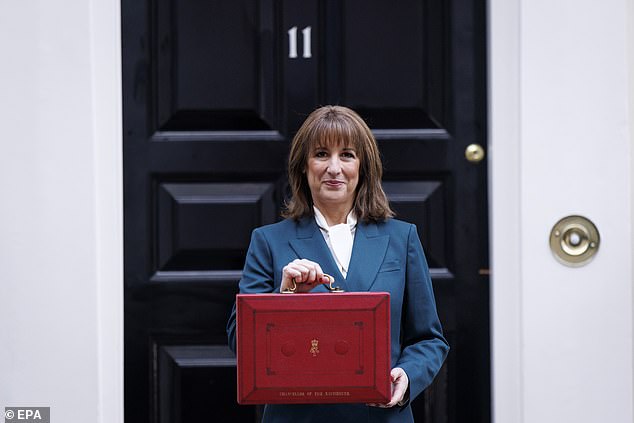

Without question the biggest and most divisive motoring policy announced in the Chancellor’s Budget was the new pay-per-mile tax on electric cars.
An electric Vehicle Excise Duty (eVED) charge will be introduced from April 2028 to plug the fiscal hole created by lost fuel duty as more drivers switch to battery-powered cars. It is predicted to raise £1.9billion for the Exchequer’s coffers by 2030.
The road pricing scheme will see EV owners having to pay a ‘modest’ 3p charge for ever mile they drive.
This is on top of the £195-a-year VED standard rate, which was only levied on EVs from April this year.
Plug-in hybrid vehicles (PHEVs) – which have small batteries and can cover up to 90 miles when driven in electric-only mode – will also be hit with eVED.
Owners of these cars will be subject to a reduced 1.5p per mile charge to reflect the fact they’re also paying fuel duty on petrol.

The most divisive motoring policy announced in the Budget was a new pay-per-mile tax scheme for electric cars
Rachel Reeves said it was ‘only right’ for EV drivers to face taxes to cover the upkeep of the nation’s roads in the same way petrol and diesel owners contribute to funds for maintaining highways and repairing potholes via fuel duties levied on every litre.
But the wider motoring industry has disagreed with the Chancellor’s tax raid on green cars.
Experts, organisations and manufacturers have in the last 24 hours openly blasted road charging for EVs as a ‘confusing’ and ‘regressive’ policy that will strangle sales of electric cars between now and the end of the decade.
And having closely scrutinised the Treasury’s consultation document on the scheme, I’ve identified five major flaws in how the Government plans to levy pay-per-mile taxation on EVs and PHEVs…
1. Owners of new EVs and PHEVs will need to visit MOT centres for ‘mileage checks’ – even when their cars don’t need to be tested
To impose a pay-per-mile scheme, every EV’s mileage needs to be checked to ensure EV drivers are paying their fair share.
Instead of using invasive telematics black boxes to record EV mileage, which have been widely opposed until now on privacy concerns, electric car drivers will be required to ‘self-report’ their mileage.
This will be based on an estimated annual mileage at the beginning of the year.
This predicted mileage-based eVED charge will be paid via the DLVA and can either be a full lump sum payment or spread across installments.
But how will the estimated mileage be audited to ensure EV owners aren’t over or underpaying on eVED?

eVED annual mileage will be audited by the MOT test, where garages will upload the vehicle’s mileage to the DVLA’s system
The Treasury says this will be checked at the annual MOT test, which already keeps a record of vehicle mileage.
However, there’s one major flaw: cars do not require an MOT until the third year after their registration.
So, how will owners of new EVs prove how far they’ve been driving each year?
Minsters say they will need to have an official ‘mileage check’ carried out by an MOT test centre – even when their vehicle doesn’t need a test to prove it is roadworthy.
While this will incur a charge from accredited garages, the Government will cover the cost of the mileage check – though hasn’t liaised with groups like the Independent Garage Association regarding what the cost will amount to.

The Government’s eVED pay-per-mile scheme is extremely vulnerable to a new age of mileage fraud
2. It will trigger a surge in mileage fraud
Understanding if drivers have met their pay-per-mile estimations each year will be based on in-vehicle odometer readings taken by MOT test centres.
And this poses a significant problem because odometers are vulnerable to tampering and mileage fraud – which is commonly known as ‘clocking’.
Vehicle history checking providers including CarVertical and HPI suggest around 2.3 per cent of all UK vehicles show evidence of having their displayed mileage fraudulently adjusted.
But while the Treasury says this practice is ‘uncommon’ and it is a criminal offence not to declare that a vehicle has been clocked when it’s sold, a raft of new mileage-tampering technologies and loopholes in the legal system mean drivers will have easy access to devices that can present a lower annual mileage to MOT centres than what they’ve genuinely clocked up over 12 months.
There has already been a big jump in the online availability and use of ‘mileage blockers’ – also advertised as ‘mileage freezers’ – in recent years, which are typically deployed to scam second-hand car buyers into overpaying or help drivers cheat to adhere to contracted mileage limits in motor finance agreements.
These devices are sold legally online and make it impossible to identify if a car’s mileage has been tampered with – even during an MOT test.
Instead of lowering the vehicle’s mileage, the devices pause it when the car is being driven.
But they don’t only pause the odometer in a car’s instrument cluster behind the steering wheel; they stop every new mile driven from registering on the vehicle’s ECU, which is essentially the car’s brain and record holder.
As such, any deleted mileage will not be identified during MOT tests or vehicle servicing.
UK sellers of these manipulative products are taking advantage of legal loopholes around clocking devices by caveating that they are ‘for off-road or research use only’, an exclusive investigation by This is Money found.
However, they are also advertised as ‘totally untraceable’ and ’99 per cent undetectable’, raising serious concerns that fraudsters could potentially target EV drivers.
The Treasury says: ‘eVED compliance arrangements will place responsibilities on owners of vehicles to report mileage correctly, to ensure their odometer is functioning and to ensure MOT results are accurate.
‘Vehicle manufacturers will retain responsibility for ensuring that, as far as possible, odometers cannot be tampered with and for assisting the government where it appears that tampering may be occurring, recognising that odometer information is often held in more than one place in a vehicle.
‘MOT garages will, as now, be responsible for making sure that mileages are recorded accurately.’
It adds that enforcement measures, including penalties, fines and court prosecutions, would likely be used to deter clocking.
It too says it could use Automatic Number Plate Recognition (ANPR) cameras to detect if unregistered EVs are being driven on the road.
Steve Gooding, director of the RAC Foundation, tells me that ‘there was never going to be an elegant, fool proof replacement for fuel duty which is so simple to collect and almost impossible to evade’ and warns eVED presents a very real temptation for ‘unscrupulous drivers to clock their battery-powered cars’.

The Government hasn’t closed the door on using telematics and black box technology to track vehicle mileage, despite claiming it eVED payments will be based on ‘self-declared’ mileage estimaitons
3. The Government could still track vehicles
While the words pay-per-mile taxation has been reverberating around parliament for a decade as the best solution to replace fuel duties and emissions-based VED when EVs become mainstream, there has been one major stumbling block that has prevented its adoption – privacy.
Government advisors have for years recommended tracking vehicle mileage using black boxes, but MPs and the public have largely opposed it as a breach of driver’s rights.
And while Rachel Reeves’ eVED policy says it will take a less invasive approach by using self-declared predicted mileage – on which a 3p per mile charge will be levied – the Treasury’s consultation document reveals there still could be an element of tracking.
While it says the government ‘will not mandate use of these telematics for administering eVED’ it says it remains open to the use of ‘various types of technologies’ that could be used on an ‘opt-in basis in future’ to simplify the system.
It says this would ‘reduce administrative burdens on motorists and businesses’.

The Treasury says eVED will rise with CPI every year from 2029-30. But is that fair after 15 consecutive years of frozen fuel duty?
4. eVED rates to increase with CPI after 15 years of fuel duty freezing
The Treasury states that the 2028 rate of tax will be 3p per mile for fully electric cars, which is around half of the 6p per mile the average petrol or diesel driver pays in fuel duty.
However, it also confirms that the rate will be uprated in 2029-30 and in future years in line with CPI inflation, to ensure that the tax ‘maintains its real-terms value’.
While it’s commonplace for taxes to be increased in-line with inflation, this hasn’t been the case for fuel duty levied on petrol and diesel drivers for more than a decade.
The tax on conventional fuels has been frozen since 2011.
Despite being forecast to increase with RPI annually, inflation-based increases have been scrapped consecutively over a 15-year period.
In 2022, a fuel duty cut was imposed by then-Chancellor Rishi Sunak to mitigate skyrocketing oil prices resulting from Russia’s invasion of Ukraine – and the cut was extended to September 2026 by Reeves on Wednesday.
With petrol and diesel drivers evading inflationary increases to their taxation for years, ministers will have to provide a very strong case for hiking eVED levies on EVs in the future.

Electric car drivers planning to take their vehicles on holiday will be charged eVED, the Government has confirmed. This is likely to be intensely opposed by EV owners
5. EV owners charged by the mile even when driving on foreign roads
The government has already confirmed it will charge eVED irrespective of where people drive their EVs, defending the decision as a move to ‘protect motorists’ privacy’, the Treasury says.
This means mileage driven overseas by UK registered cars will fall into scope of eVED, where British motorists will likely incur other forms of domestic taxation.
This isn’t the case with fuel duty on petrol and diesel cars as each time they fill up in a foreign country they will be paying a tax on every litre that’s collected by that nation’s government.
‘Since the proportion of UK registered cars driving abroad each year is a small proportion of total cars, it is proportionate to prioritise privacy and simplicity over a system of checks to deduct non-UK mileage,’ the consultation document states.
It means the 3p per mile levies will apply when Britons take their cars on holiday – and likely face double taxation.
For instance, those visiting France would pay eVED on top of ‘péage’ tolls, which exist on French motorways.
On average, it would mean a 1,530-mile trip from Calais to Nice would cost an extra £45.90.
This rule is likely to face huge objection from motoring groups, with AA president Edmund King calling a tax on EV owners for driving their green cars outside of the UK ‘unfair and a huge flaw’.
Steve Gooding from the RAC Foundation told me: ‘For the average holidaymaker taking their vehicle abroad once a year it probably doesn’t matter too much that they are paying UK taxes on foreign miles, after all many petrol and diesel drivers will have filled up at home before travelling beyond our borders and hence paid domestic fuel duty.
‘However, for those heading overseas more frequently or for business there are going to have to be some serious calculations done on which taxes, tolls and charges they are having to pay and where.’
#major #flaws #paypermile #tax #EVs #Motoring #editor #ROB #HULL #Budget #bombshell