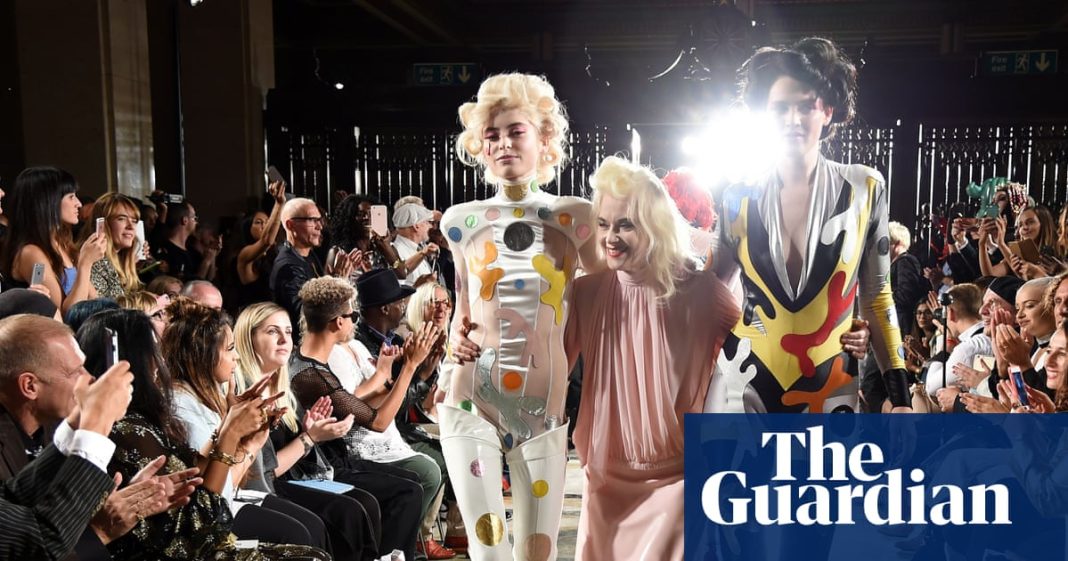

There are people who live life to the full, then there’s Pamela Hogg. Pam’s tenure on this earth is a trawl through just about every significant cultural and creative moment in the UK over the last 30-odd years. One of our most groundbreaking artists, Pam was a colourist of Warholian proportions, creating art to be hung on the body rather than the walls of a gallery. She was a punk who provocatively mashed up gender and sexual stereotypes. Fashion was the art form that freed her imagination, and her success was due to her talent and drive being greater than her disdain of the conformist industry and the gatekeepers surrounding it.
I sat in St Joseph’s hospice in London by her unconscious but serenely beautiful figure – as if she’d made her exit into another work of art – telling her that her jam-packed life was characterised by creativity, independence, courage and kindness. “Hoggy, you left absolutely nothing on the table.”
Born in Paisley into a close-knit family, the young Pam was a feisty ingredient added to a soup already brimming with fabric, colour and design. Often seeming on the verge of being swallowed up by Glasgow, Paisley retains its fierce independent spirit; shaped by textiles, political activism, a strong civic culture and aesthetic sensibility. “There was no art in our house, but there was always a sense of adventure, imagination, and an openness to be ourselves,” Pam told me. “My father taught me to be unafraid to be different.”
Glasgow School of Art was a revelation. “It seemed crazy that there was an institution where you would go to do what I loved best. It drew me in like a life force.” London then called, but the Royal College of Art was secondary to her development. The Blitz club, with its Steve Strange-policed door policy – dress fabulously and outrageously – proved the real catalyst for Pam’s fashion future. “London club life seized my imagination. That’s when I started designing with a purpose. I may not have chosen fashion … but fashion had chosen me.”
I first ran into her on a wet 1980s Soho night. My girlfriend (stylish) and I (less so) were fretting about getting into the Wag Club. I was completely unknown to her, but Pam – whose collections were by now stocked at Harrods, Harvey Nichols and stores in Paris, Milan, Rome and Tokyo – clocked my accent and said, “Come in with us …” So, through those doors we accompanied that glamorous London “face” with the weedgie accent.
As I struggled through ill-suited jobs (all of them), Pam went stellar. The years between 1985 and 1989 saw six collections, culminating in her iconic i-D magazine cover. Opening her own Soho boutique cemented her status as a fashion pioneer, with Debbie Harry, Siouxsie Sioux, Björk and Kylie all becoming ambassadors for those skin-tight designs. In 1990, with Terry Wogan introducing her on his show, Pam had moved from cult to mainstream.
Or not.
The fashion world was at her feet, but her punk antennae were agitated. A raunchy guitarist and singer who loved rock’n’roll, she stepped away from it all, forming the band Doll and taking them on the road. We became close friends in the 90s – touring together, clubbing and partying in the way those times demanded. Possessing a photogenic beauty and wild charisma that few of her models could match, she also had a hunger to perform. I loved how her sass was complemented with a deep humility and capacity for genuine engagement with people. From a Hackney squat to a Manhattan rooftop, it thankfully seemed no party or club on the planet was safe from Hoggy rocking up.
Her nose for a phoney unparalleled, Pam never wanted an infrastructure of staff, administrators and financiers, and self-funded many shows to retain creative control. Those principles cost, heaping stress on her as she operated her sewing machine in her Hackney workshop, literally until her fingers bled and stiffened with arthritis.
Life now seemed to be mainly about bands and DJing, but the art world hadn’t forgotten her. Her work featured in the 2006 exhibition Switch on the Power, alongside that of Yoko Ono, Andy Warhol, Leigh Bowery and Kraftwerk. Then Kylie Minogue’s 2010 appearance in Pam’s metal-studded catsuit shoehorned her back to the top table she’d always sat ambivalently at. I largely missed this comeback, having moved overseas and only intermittently hooked up with her on return visits home. Though I’m twice her size, I’d inevitably be greeted with, “Irvine … ma wee darlin’ …”
She sailed through the 2010s on a flotilla of hit shows and awards, using her talents to pay tribute to Pussy Riot during the Russian Olympics, and followed other elite artists like Damien Hirst and Tracey Emin in designing Brit Award statuettes. Then her hometown museum commissioned the large-scale print Paisley Poodle for installation as a permanent exhibit.
Just before Covid, I returned to the UK. Immediately after lockdown, the first social event was Terry Hall’s curation of a city of culture gig in Coventry. Pam and I headed to the Midlands along with Pete Doherty and the Fat White Family. It was a fabulous occasion: none of us were great at being locked up.
I attended her last show, Of Gods and Monsters, which was exhibited in London and described by Keyi magazine as, “a profound reflection on humanity, resilience, and the necessity for change … Pam Hogg’s exhibition reminds us that fashion can be both beautiful and deeply political, a tool for activism as much as aesthetic expression.” That year, 2024, she fittingly received the Icon award for services to fashion and philanthropy. “To accept this award is to highlight and aid in the unacceptable struggles of all children here and around the globe,” Pam said when accepting it. “This has to end.” Devastated by the mass murder of children in Palestine, Pam posted prolifically about this, when personal survival might have been her main concern, as it was now obvious that she was struggling with her health.
On a canal walk in east London, she told me her situation. Though I was stunned, she remained positive. Even when her condition hospitalised her, and she weighed less than the tracksuit she wore, she asked me to bring in some weights in order to build up her muscle tone. Pam’s massive heart was spared the ache of knowing that our mutual friend Mani died less than 48 hours before her. We’d both attended the funeral of his wife, the wonderful Imelda, just two years ago. Like Mani, Pam had time for absolutely everyone. The Paisley Princess occasionally enjoyed swaggering through the doors her fame opened but never, ever, wanted them slammed in anybody else’s face. Not even a daft young guy from Leith, skulking outside a club with his bird on a drizzly Soho night.