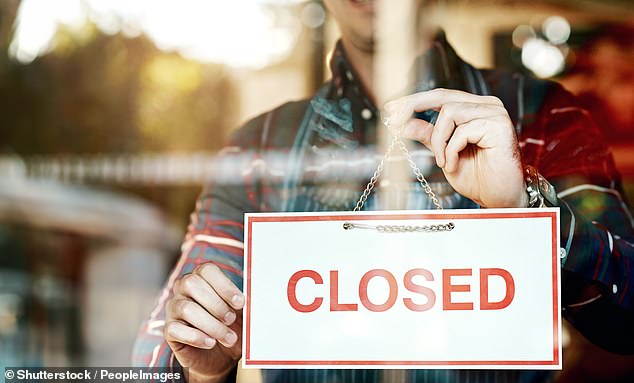

Uncertainty surrounding the Autumn Budget, higher company taxes and stubborn inflation are pushing swathes of British business to the brink.
The number of businesses in ‘critical’ financial distress has surged 78 per cent year-on-year, with 55,530 companies affected in the third quarter of 2025, compared to 31,201 a year ago, according to figures compiled by Begbies Traynor.
The professional services group said the increase marked a 12.6 per cent rise in the number of businesses in ‘critical’ financial distress compared to the second quarter of this year.
Julie Palmer, a partner at Begbies Traynor, said: ‘The steep increase in businesses in “critical” financial distress shows the UK economy is in real trouble.’
Businesses have already been hit hard by Rachel Reeves introduction of higher employer national insurance contributions and minimum wage costs.
Of the 22 sectors covered by the findings, 21 experienced a rise in ‘critical’ financial distress of more than 40 per cent against the same period last year, Begbies Traynor said.

Tough times: Uncertainty surrounding the Autumn Budget , higher company taxes and stubborn inflation are damaging swathes of British business, findings show
Consumer-facing industries continued to be under the most severe pressure, with leisure and cultural activities, hotels and accommodation and general retailers experiencing ‘some of the most extreme increases in critical financial distress’.
‘Significant’ financial distress also jumped 14.8 per cent year-on-year to 726,594 firms, following a 9 per cent rise from 666,876 in the second quarter of this year.
Of the 18 of 22 sectors experiencing an annual rise in ‘significant’ distress, utilities real estate and property services and financial services experienced the highest growth, the research found.
Looking at all its findings, Begbies Traynor said the results showed a ‘considerable deterioration’ in the financial health of many business compared with the same period last year.
Palmer said: ‘With over 55,000 companies now in serious financial distress, the upcoming Budget must deliver urgent support to avoid a wave of failures, especially among SMEs already operating on a knife edge.
‘Unfortunately for UK businesses, inflation is going nowhere, putting further pressure on companies at a time when wage, tax, and financing costs are already high.
‘Many firms have no room to manoeuvre, and instead of investing for growth, are scaling back just to survive – the opposite of what the economy needs, if it’s going to recover and grow.’

Under pressure: Rachel Reeves is under pressure to deliver for businesses
She added: ‘The Government must get the Budget in November right, but the Chancellor faces a delicate balancing act between delivering “business friendly” measures while balancing the books.
‘There has been a lot of temperature testing in the run up to November, but it is critical that the final measures are decisively pro-business.
‘We are entering a critical phase. Consumer-facing sectors like retail, hospitality and leisure are already in deep distress and have little capacity to absorb further shocks or pressures on consumers, while many other industries are also treading water.
‘Without meaningful support, we can expect more restructuring, rising insolvencies and a continued loss of economic confidence well into 2026.’
Ric Traynor, executive chairman of Begbies Traynor, said: ‘Many UK businesses are having to deal with a number of intense pressures, including rising geo-political uncertainty, tariffs, and the deteriorating economic situation in the UK, which is suffering from stubbornly high inflation, high taxation and high borrowing costs.
‘With confidence and investment both subdued, the challenges for businesses remain substantial.’
He added: ‘Rising insolvencies, weak productivity and growing unemployment all point to a wider slowdown that is now becoming evident in almost every sector.
‘With public finances stretched and Government borrowing running above forecast, the Chancellor faces very difficult decisions ahead of the Autumn Budget.
‘Any measures that shift more of the burden onto businesses will only deepen the uncertainty facing them as they look ahead to 2026.
‘Additionally, with consumer confidence so volatile, anything that increases the tax burden on individuals is likely to have a disastrous effect on consumer-facing industries like hospitality.’
Over a quarter of Scottish business expected to shrink
More than a quarter of Scottish small business expect to shrink over the coming year, the Small Business Index has found, as it reported its second-lowest quarterly revenue results in its 15-year history.
The survey, from the Federation of Small Business, showed that 29.1 per cent of small businesses expect to contract over the next year, compared to just 6.4 per cent expecting to grow.
Fifty-seven per cent of small firms in Scotland said their profits fell during the latest financial quarter.
The proportion reporting revenue growth fell to a net balance of minus 43.7 per cent – the second-lowest quarterly revenue results in 15 years.
Small business confidence in Scotland has fallen to a net rating of minus 69.0 – a significant drop on the previous quarter, the report found.
The drop in confidence in Scotland was one of the steepest among all parts of Britain with only the East Midlands and West Midlands experiencing a greater drop in the third quarter. The UK-wide SBI also fell, 14.1 points, to minus 58.1.
Nine in 10 Scottish small businesses experienced increased running costs, with higher tax, labour and utility bills being the biggest drivers.
Looking ahead, fewer than one in 10 small Scottish businesses expect to see an increase in profits over the next three months, which is significantly down on the previous quarter.
The FSB said the results highlighted the need for urgent government action to kickstart the economy.
Guy Hinks, FSB Scotland chair, said: ‘What Scotland’s small businesses need to see is tangible steps being taken to get the economy moving again.
‘We’re calling on Rachel Reeves to take bold action in the Budget to support entrepreneurship and ease tax and employment cost burdens on small firms – we must turn this around and enable small businesses to grow rather than having their ambitions held back, and in turn hampering economic growth.
‘The economy cannot afford for small firms, who employ more than a third of Scotland’s total workforce, to stop hiring or cut staff.’
He urged the government to increase the employment allowance which would help small employers offset the cost of national insurance.
Hinks added: ‘Other positive steps could include a Statutory Sick Pay rebate, to help small employers manage the £5billion annual cost to UK small businesses of sickness absence.
‘Increasing the VAT turnover threshold to £100,000 would also encourage growth.
‘At the same time, the Scottish Government should seize the opportunity offered by its Community Wealth Building Bill to tackle some of the challenges facing small firms bidding for public contracts.
‘This should include targets for increased spending with small and local businesses to ensure the Bill delivers on its aims.’
A spokesperson for the Scottish Government said: ‘We are calling for the Autumn Budget to deliver real support for public services, infrastructure and the cost of living.
‘We continue to call on the UK Government to reverse its damaging decision to raise employers’ National Insurance contributions and work with us to develop tailored migration routes, including a Rural Visa Pilot, to help Scotland’s small businesses to thrive.’
A government spokesperson said: ‘Small business owners put in the hard graft every day and we are backing them by tackling the scourge of late payments that cost the economy £11billion a year and boosting access to finance so they can invest and grow.
‘Through our Small Business Plan – the most comprehensive support package in a generation – we are taking a pro-business approach that has helped interest rates to fall five times since the election, established historic trade deals with the US, EU and India, and are reforming business rates, cutting red tape and speeding up licensing reforms.
‘These are all efforts to help lower costs for businesses and have helped deliver the fastest growth in the G7 since the start of the year.’
DIY INVESTING PLATFORMS
AJ Bell
AJ Bell
Easy investing and ready-made portfolios
Hargreaves Lansdown
Hargreaves Lansdown
Free fund dealing and investment ideas

interactive investor
interactive investor
Flat-fee investing from £4.99 per month

InvestEngine
InvestEngine
Account and trading fee-free ETF investing

Trading 212
Trading 212
Free share dealing and no account fee
Affiliate links: If you take out a product This is Money may earn a commission. These deals are chosen by our editorial team, as we think they are worth highlighting. This does not affect our editorial independence.
Compare the best investing account for you
#Number #British #business #critical #financial #distress #surges #ahead #Budget