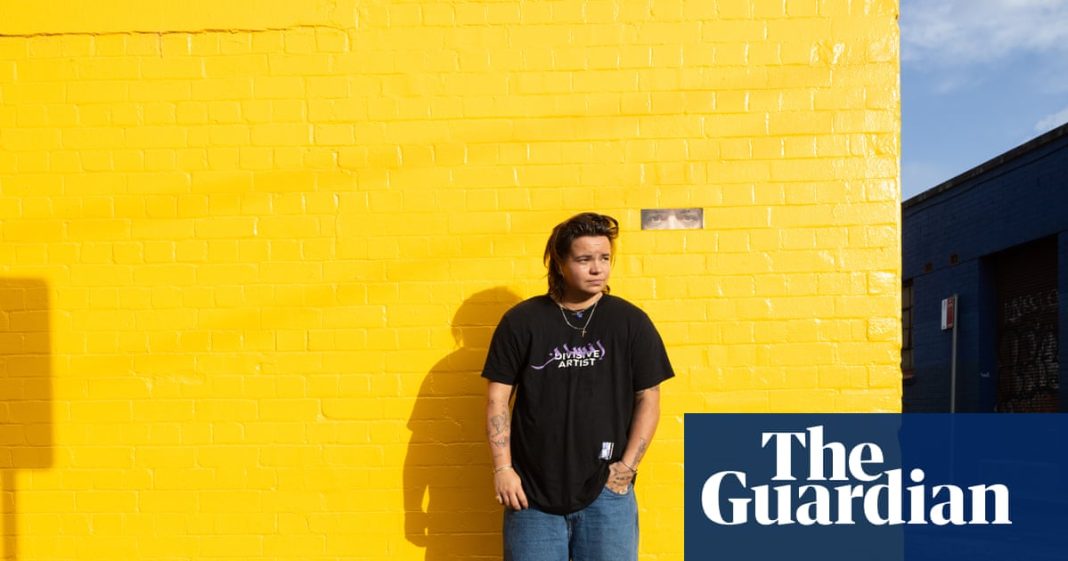

There’s some kind of cosmic justice for the under-resourced Australian film industry in the fact that Zoe Terakes is more often recognised on the street for their role in Adelaide-made indie horror film Talk To Me than for Marvel’s multimillion-dollar series Ironheart, out earlier this year. “When it’s Talk to Me, I’m like, ‘Yeah, respect!’” Terakes says, grinning.
We’re walking down the main drag in Dulwich Hill, Terakes’ neighbourhood, on a sweltering October afternoon. The air is heavy and humid and the sky apocalyptic, so after picking up takeaway treats from their favourite Greek-owned coffee spot, Honey and Walnut Patisserie – decaf; crescent-shaped amygdalota (almond biscuits) and pillowy jam-daubed indokarida (coconut macaroons) – we head to their share house.
We settle on well-worn couches on a concrete back porch overlooking a sprawling back yard, its unkept lawn bordered by unruly and overgrown garden beds. Terakes rolls and smokes durries – their only vice, they protest – as rain belts down on the sheet roofing.
The storm is, we decide, appropriate for the topic at hand: Terakes’ first book, a collection of queer and erotic takes on Greek myths titled Eros. In it, the weather speaks for gods and humans alike: a blast of sun marks the homoerotic yearning of sun god Apollo for his young human lover, Icarus; a violent storm echoes a trans teen’s anger at the gods for assigning him a female body.
Now 25, Terakes has been acting for almost a decade, including screen-stealing roles in Janet King, Wentworth and Nine Perfect Strangers, opposite Nicole Kidman.
Off screen, they’ve become a prominent advocate for trans issues, breaking barriers in representation; the first non-binary Australian actor in consideration for the Aacta award for best lead actor in a feature (for queer coming-of-age comedy Ellie & Abbie), and the first trans and non-binary actor to be cast in the Marvel Cinematic Universe, as ex-athlete Jeri Blood, the muscle in the misfit gang of criminals at the centre of Ironheart.
Terakes’ transition to writing took even their parents by surprise – and the fact that it is mythological fiction feels like an extra plot twist.
But Terakes’ interest in Greek mythology has deep roots. “I think it’s a combination of growing up as a freaky little queer kid who was, like, obsessed with getting my hands on anything kind of dark and weird, and then also just being Greek,” they say.
Or more accurately: Cretan. Terakes’ family hails from a tiny village on Crete, a culturally distinct island that was home to the ancient Minoans and later passed around between the Romans, Venetians and Ottomans, before becoming part of Greece little more than a century ago.
Terakes, who travelled to Crete for the first time while writing the book, says they used to identify as Greek – “but now I’m saying Cretan more, because it’s just so different there. The culture’s different. The food’s different. I loved Athens, but I didn’t feel that [sense of connection] until I set foot on Crete.”
Crete is a key site of Greek mythology: home to Psychro Cave, the supposed birth site of Zeus, and the setting for myths about the Minotaur and the labyrinth, and Icarus, who flew too close to the sun.
All these stories are woven into Eros. There’s also a contemporary twist on Eurydice (with very little Orpheus); Hermaphroditus, an homage to the queer communities of Aids-era Kings Cross and inner-west Sydney; and Artemis and Kallisto, a time-hopping fantasy that travels from ancient Crete to modern-day northern rivers New South Wales, and is infused with the Terakes family’s migrant history.
The queerness exists in the original material, Terakes points out – they just liberated it. Take the story of Iphis: a boy born in a female body who falls in love with his childhood friend Ianthe, and eventually persuades the gods to give him a man’s body. The best-known version of the story, by Roman poet Ovid, is steeped in homophobia. “For about half a page, he talks from the perspective of Iphis about how disgusting it must be to yearn for another woman when you yourself are a masculine woman,” Terakes says.
Terakes’ version reclaims it as a tale of trans love that’s horny and hallucinatory, laced with body horror, fiercely tender.
The rain is so loud it’s hard to hear ourselves, and we’re forced inside to the living room: a maximalist mix of mid-century and 70s-era design that Terakes describes laughingly as “wog”.
The conversation turns to their experience coming out in public, which they only started to process a year ago. “Having to transition in front of an industry and in public fucks you up a bit,” they say.
Terakes was 16 when they did their first audition, for legal drama Janet King. They nailed it and were cast in the key role of troubled teen Pearl Perati. They made their stage debut the following year, playing another troubled teen – Catherine, in Arthur Miller’s A View From the Bridge. Around the same time, they came out publicly as gay.
A View From the Bridge was so successful it toured for two years. In the middle of that run, Terakes came out as non-binary and trans. At the time, they could name two other trans actors in the country: Janet Anderson and Morgan Davies (both now friends). “Three kids just making shit up,” Terakes says. “I had casting directors being like, ‘So what, are you playing boys now or are you playing girls?’ People didn’t know what being non-binary was.” On sets, Terakes found themselves the de facto consultant on everything trans.
after newsletter promotion
Meanwhile, “the awkward in-between bits where you’re going through second puberty are captured for all eternity on television,” they say.
“I look back at Nine Perfect Strangers, and I’m like, ‘God, they were figuring some stuff out!’ Like, what was my hair doing?” Terakes laughs, then sobers. “I hadn’t had surgery yet, but very much was wanting to. I wasn’t financially able to. So you’re having to present what feels like a half-baked version of yourself.”
Filming Wentworth was a particular “headfuck”, Terakes says: “Wanting top surgery so badly, and then playing a role where that person wants it too, but can’t get it.”
“It’s a privilege to be able to keep working while you’re transitioning,” Terakes hastens to say. “That’s something most trans people don’t get. It is also really challenging.”
The storm has subsided, and we set out again on the now-steaming streets, down Marrickville Road, passing the library where Terakes wrote much of Eros.
Terakes may not get recognised in the street for their Marvel role, but it was life-changing. It gave them the money to get top surgery, in late 2022, and to research and start writing Eros the next year.
Ironheart was a blast to make, too. “The cast and crew was so black, so brown, so queer. It was helmed by black women. It was unlike anything I’d ever been on,” they say.
“And I’d never felt so respected in my life. About two weeks in, having not been misgendered once, I pulled the producer aside and I was like, ‘Did you threaten these people?’ She was like, ‘Nope. At the start of pre-production, we told everyone: ‘Start now. It’s OK if you make mistakes, but you need to start now, before trans people get here.’ Which is what every production I’ve done in so-called Australia says they do, but miraculously, nobody’s ever heard that I’m trans until I rock up on set.”
Terakes also relished being in a role that had nothing to do with being trans. “It’s really a gift to not have your character’s identity be their entire story. They get to just be a character, like everybody else.”
It starts to rain again and I thrust an umbrella at Terakes, worried they’ll be wet for the photoshoot. “Oh, I don’t care! I don’t care at all,” they demur cheerfully, running a hand through their hair and shaking out raindrops.
We find our photographer, and a suitably photogenic lane-way – and suddenly the sun busts through clouds in full force. The gods of Marrickville are smiling.